
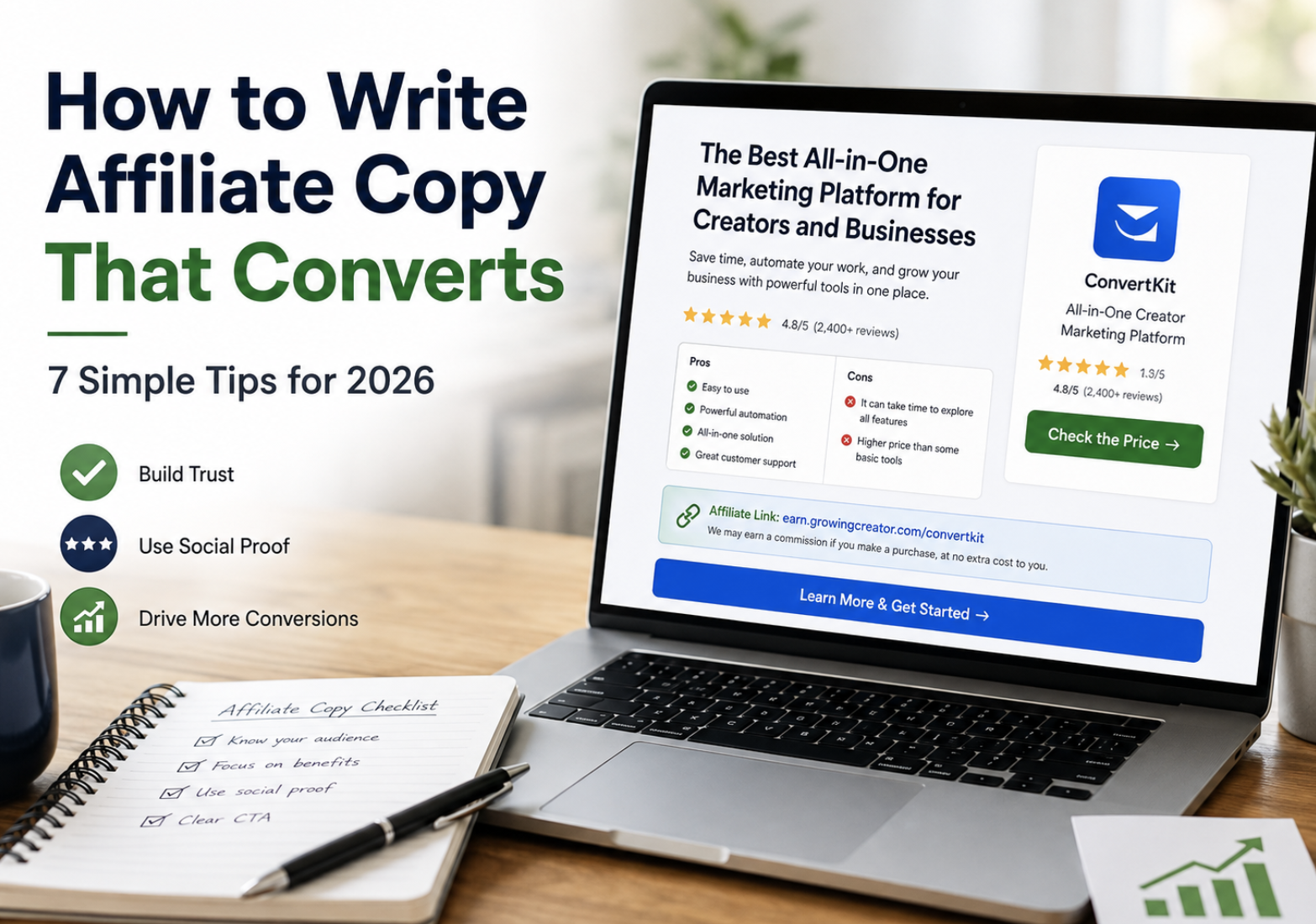
How to Write Affiliate Copy That Converts: 7 Simple Tips for 2026
We may earn money or products from the companies mentioned in this post.
Updated August 2026
Good affiliate copywriting is not about pushing people into buying something.
It is about helping your reader understand a product, see whether it solves their problem, and decide what to do next.
That difference matters.
Readers have become very good at spotting exaggerated promises and aggressive sales language. If your content sounds like one long advertisement, people are likely to leave.
Effective affiliate copywriting takes a different approach.
You explain the problem clearly. You show your reader how a product or service may help. You answer their questions. You discuss the good and the bad. Then you give them a clear next step.
In this guide, I will show you seven simple ways to write affiliate copy that feels natural, builds trust, and gives you a better chance of turning readers into customers.

What Is Affiliate Copywriting?
Affiliate copywriting is writing content that encourages someone to take an action through your affiliate link.
That action could be:
- Visiting a product website
- Starting a free trial
- Signing up for a service
- Requesting more information
- Buying a product
However, good affiliate copywriting should never feel like pressure.
Your first job is to help your reader.
The sale comes second.
This is especially important if you run an affiliate website. Readers need a reason to trust your recommendation before they click your link.
You cannot simply say a product is “amazing” and expect people to believe you.
You need to explain why it may be useful.

1. Understand Who You Are Writing For
Strong affiliate copywriting starts before you write your first sentence.
You need to know who your reader is.
Ask yourself:
What problem brought this person to my website?
What are they worried about?
What have they already tried?
What information do they need before making a decision?
For example, someone searching for an affiliate marketing platform may be completely new to online business.
They probably do not need complicated marketing language.
They want simple answers.
They may want to know:
- How much does it cost?
- Is it difficult to use?
- Can a beginner understand the training?
- Does it include website hosting?
- Are there hidden costs?
- How long does it take to learn?
When you answer those questions, your affiliate copy becomes far more useful.
Write for One Reader
Imagine you are explaining the product to one person sitting across the table from you.
That usually produces more natural writing.
Instead of writing:
“Users can benefit from the platform’s comprehensive range of advanced marketing features.”
You could say:
“You get the training, website tools, hosting, and research tools in one place.”
The second version is easier to understand.
That is what good affiliate copywriting should do.
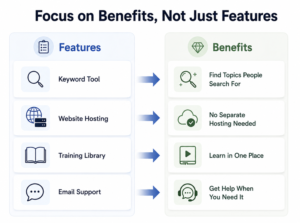
2. Focus on Benefits, Not Just Features
One of the most common affiliate copywriting mistakes is listing features without explaining why they matter.
Features tell readers what something has.
Benefits explain why those features matter to them.
Suppose an affiliate platform includes keyword research software.
The feature is:
“Keyword research tool included.”
That tells the reader very little.
The benefit could be:
“The keyword tool can help you find search terms people are already using, so you have a better idea of what topics to write about.”
That explains the value.
Here is another example.
Feature: Website hosting included.
Benefit: You do not need to find and pay for a separate hosting company before building your website.
Benefits make products easier to understand.
Whenever you mention a feature, ask:
So what?
Why should your reader care?
The answer is usually the benefit.
3. Start With the Reader’s Problem
Good affiliate copywriting connects with the problem before introducing the solution.
Think about why someone searched for your article.
They did not wake up wanting to read marketing copy.
They have a question or problem they want solved.
For example:
You may want to start affiliate marketing but feel overwhelmed by all the different platforms, tools, courses, and advice online.
That opening speaks directly to a real beginner problem.
You can then explain how the product or service relates to that problem.
This approach is much more natural than immediately saying:
“Buy this product because it is the best.”
Do Not Invent Problems
Be specific, but stay honest.
Do not exaggerate a reader’s fears just to make a sale.
You do not need statements such as:
“If you don’t buy this today, your online business could fail.”
That creates pressure rather than trust.
Trustworthy affiliate copywriting should inform readers, not scare them.
4. Explain Why You Recommend the Product
Readers want to know why they should listen to you.
This does not mean you need to pretend you are an expert in everything.
Be clear about your experience.
If you have personally used a product, say so.
Explain:
- How long you have used it
- What you use it for
- What you like
- What you dislike
- Who you believe it suits
- Who may be better choosing something else
Personal experience can make affiliate copywriting much stronger because you can discuss things that a basic product description may not mention.
For example:
“I like having website hosting, training, keyword research, and support inside one platform because it means I do not have to manage several separate services.”
That tells the reader why the feature matters to you.
Include the Negatives Too
No product is perfect.
If your article only contains praise, readers may question how objective the review really is.
Mention genuine limitations.
You might say:
“The training is extensive, which can be useful, but beginners may feel overwhelmed if they try to complete too much at once.”
That does not destroy the recommendation.
It makes it more believable.

5. Use Clear Calls to Action
A call to action tells your reader what they can do next.
You have probably seen calls to action such as:
- Learn More
- Start Free
- Check the Latest Price
- Visit the Official Website
- See What Is Included
The wording does not need to be clever.
It needs to be clear.
A reader should know what will happen after clicking.
Match the Call to Action to the Article
Your call to action should make sense in context.
For example:
“If you want to see exactly what the platform includes before making a decision, you can visit the official website here.”
That feels natural.
Compare that with:
“BUY NOW BEFORE YOU MISS OUT!”
The second version creates unnecessary pressure.
Affiliate copywriting works better when the call to action feels like the next logical step.
Do Not Add Affiliate Links Everywhere
More affiliate links do not automatically mean more sales.
Too many links can distract readers and make an article look promotional.
Place your links where they are useful.
Good locations may include:
- After explaining a major benefit
- Inside a comparison table
- After your recommendation
- Near the final verdict
- Inside a clear call-to-action section
Give people a reason to click before asking them to click.
6. Write Like a Person, Not an Advertisement
Some affiliate articles sound as though every sentence came from a sales brochure.
Avoid phrases such as:
“Revolutionary opportunity.”
“Life-changing system.”
“Guaranteed success.”
“Unbelievable profit potential.”
These claims can make readers suspicious.
Simple writing is usually more convincing.
Instead of:
“This groundbreaking platform provides an unparalleled opportunity to revolutionize your online entrepreneurial journey.”
Try:
“This platform gives beginners several of the tools they need to build and manage an affiliate website.”
The second sentence tells the reader something useful.
Keep Your Sentences Short
Short sentences make online content easier to read.
They are especially helpful on phones.
Long paragraphs can look overwhelming on a small screen.
Try to keep most paragraphs between one and three sentences.
Use headings to separate ideas.
Use bullet points when readers need to compare information quickly.
Clear formatting is part of good affiliate copywriting because readers are more likely to stay when an article is easy to follow.
7. Make Your Recommendation Specific
One of the strongest things you can do at the end of an affiliate article is explain exactly who the product is for.
Do not simply write:
“I highly recommend this product to everyone.”
Very few products are right for everyone.
A more useful recommendation would be:
“This platform may suit beginners who want training, website hosting, research tools, and support in one place. It may not be the best choice for someone who already has hosting, advanced marketing experience, and their own preferred tools.”
That gives your reader something useful to think about.
Help Readers Make Their Own Decision
Your goal is not to force every visitor through your affiliate link.
Your goal is to attract the right people.
That can actually lead to better conversions because the people who click already understand what the product offers.
Honest affiliate copywriting filters out poor matches while helping suitable readers move forward.
Why Trust Matters More Than Clever Sales Tricks
A visitor may read several of your articles before buying anything.
That is why trust has long-term value.
If readers believe you give balanced information, they are more likely to return to your website.
They may also read other reviews, comparisons, tutorials, and recommendations.
One aggressive sales page might produce a click.
Trust can produce a returning reader.
That is far more valuable for an affiliate website.
Pros of Good Affiliate Copywriting
- Builds reader trust by giving clear and balanced information.
- Improves conversions by helping readers understand why a product may suit their needs.
- Makes content easier to understand by focusing on benefits instead of complicated sales language.
- Creates long-term value because helpful readers may return to your website for future advice.
Cons to Watch Out For
- Too much sales language can reduce trust and make readers leave.
- Overpromising can damage credibility if the product does not deliver what you claim.
- Ignoring product weaknesses can make a review feel biased rather than helpful.
- Too many affiliate links can distract readers and make the article look overly promotional.
Common Affiliate Copywriting Mistakes to Avoid
Even a good article can lose readers when the copy becomes too promotional.
Here are several mistakes worth avoiding.
Making Unrealistic Income Claims
Do not imply that buying a product automatically leads to income.
Affiliate marketing takes work.
Results vary.
Products and training can help, but they cannot guarantee success.
Talking Only About the Product
Keep bringing the discussion back to the reader.
Instead of listing feature after feature, explain how each one could help solve the reader’s problem.
Using Too Much Hype
Words such as “amazing,” “incredible,” and “revolutionary” lose their effect when they appear constantly.
Facts are usually more persuasive.
Hiding Important Drawbacks
Readers deserve to know about meaningful disadvantages.
That includes pricing, learning curves, limitations, and extra costs.
Forgetting the Next Step
Do not leave the reader wondering what to do.
If you believe the product is worth considering, explain the next logical action clearly.
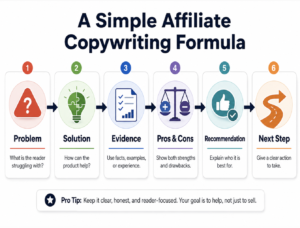
A Simple Affiliate Copywriting Formula
You do not need a complicated formula to write persuasive affiliate content.
Use this basic structure:
1. Identify the Problem
Explain what the reader is struggling with.
2. Explain the Solution
Show how the product or service may help.
3. Provide Evidence
Use your experience, examples, features, pricing, screenshots, comparisons, or other useful information.
4. Discuss the Pros and Cons
Give the reader a balanced view.
5. Recommend Who It Is For
Explain which type of person would benefit most.
6. Give a Clear Next Step
Tell readers where they can learn more if they are interested.
This simple structure can work for reviews, comparisons, tutorials, product recommendations, and many other affiliate articles.
Can Affiliate Copywriting Increase Conversions?
Better affiliate copywriting can improve your chances of converting readers because it removes confusion.
People hesitate when they do not understand:
- What a product does
- How much it costs
- What they receive
- Whether it suits beginners
- Whether they can trust the recommendation
- What happens after they click
Your content should answer those questions.
The easier you make the decision, the less selling you need to do.
Affiliate Copywriting and SEO Work Together
SEO may bring someone to your website.
Your writing then needs to keep them there.
That is why affiliate copywriting and SEO should work together.
Use your main keyword naturally.
Answer the reader’s search question.
Use clear H2 and H3 headings.
Add useful internal links.
Link to related articles where they help the reader.
Avoid repeating the same keyword unnaturally just to increase its usage.
For this article, the main keyword is affiliate copywriting.
Related phrases can include:
- affiliate marketing copywriting
- writing affiliate content
- affiliate sales copy
- copy that converts
- affiliate marketing content
- writing product recommendations
- affiliate conversions
These related terms help you discuss the topic naturally without repeating the exact same phrase in every paragraph.
Frequently Asked Questions About Affiliate Copywriting
What Is Affiliate Copywriting?
Affiliate copywriting is content written to help readers understand a product or service and encourage them to take a useful next step. This may include clicking an affiliate link, comparing options, starting a free trial, or making a purchase.
Do I Need to Be a Professional Copywriter?
No. You do not need professional copywriting experience. Focus on understanding your reader, explaining products clearly, staying honest, and making your content easy to follow. Your affiliate copywriting skills will improve with practice.
How Do I Write Affiliate Copy That Converts?
Start with the reader’s problem. Explain how the product may help, focus on benefits, provide useful evidence, discuss the pros and cons, and give readers a clear next step. Good affiliate copywriting helps people make decisions without putting them under pressure.
Should Affiliate Articles Sound Like Sales Pages?
Usually not. Affiliate articles often work better when they feel helpful and informative. You can recommend a product and encourage readers to take action without making every paragraph sound like a sales pitch.
Should I Mention Product Disadvantages?
Yes. Balanced affiliate copywriting should include meaningful disadvantages as well as benefits. Discussing limitations helps readers make informed decisions and can make your recommendations more trustworthy.
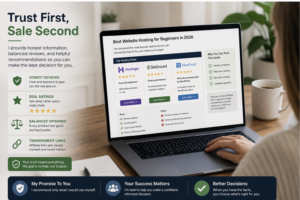
Final Thoughts: Good Affiliate Copywriting Starts With Trust
The best affiliate copywriting does not feel like someone chasing a commission.
It feels like someone helping you make a decision.
Understand your reader first.
Explain benefits instead of simply listing features.
Talk about genuine advantages and disadvantages.
Keep your writing clear.
Use calls to action where they make sense.
Most importantly, recommend products because you believe they may genuinely help the right person.
When readers trust your content, you do not need aggressive sales tactics.
You give them the information.
You explain their options.
Then you let them decide.
That is a much stronger foundation for building an affiliate business that lasts.
Ready to Put Your Affiliate Copywriting Skills Into Practice?
Learning how to write affiliate copy is only one part of building an online business.
You also need a website, keyword research, training, and somewhere to learn how affiliate marketing works.
That is one reason I use Wealthy Affiliate.
It brings several of those tools together in one place and is designed to help beginners learn affiliate marketing step by step.
If you want to see what Wealthy Affiliate includes, along with the advantages and disadvantages I have found from using it myself, you can read my full review before deciding whether it is right for you.
Thank you for reading. I hope these affiliate copywriting tips help you create clearer content and make better recommendations to your readers.
Wishing you every success,
Elke