
How To Grow Affiliate Income With 5 Micro-Niche Strategies
We may earn money or products from the companies mentioned in this post.
Updated on the 13 October 2025
How To Grow Affiliate Income
Welcome to SoleAffiliate. This article shows you how to grow affiliate income with micro-niche strategies in 2025.
You’ll learn what a micro-niche is, why it’s winning right now, and how to choose one that fits your audience and goals.
Wondering, “What’s the best micro-niche to start in 2025?” You’ll get clear answers, real examples, and a simple plan to follow—so you can build a reliable online income stream with focused, helpful content.
What Is a Micro-Niche?
A micro-niche is a focused slice of a larger market. Instead of covering broad topics like “fitness,” you zoom in on something more specific — like home workouts for women over 50 or plant-based protein shakes for busy parents.
It’s not about going smaller for the sake of it. It’s about finding a corner of the market where:
- People are already searching for solutions
- Competition is low
- You can become the go-to expert
Micro-niches are powerful because they let you grow faster, build authority, and connect with a loyal audience that trusts your advice.

Why Micro-Niches Work in 2025
More people than ever are starting blogs, YouTube channels, and affiliate websites. That means the broad topics — tech, beauty, fitness — are packed.
But smaller, focused topics are where the new money flows.
Here’s why:
- Less competition means you can rank quicker on Google.
- Higher engagement — people searching for specific solutions stay longer.
- Better conversions — readers click and buy when content solves their exact problem.
Think of it as choosing a quiet street with hungry customers instead of shouting in a crowded mall.
5 Micro-Niche Strategies to Boost Affiliate Income
1. Choose a Sub-Niche You Know
Start where you have experience. If you’re into tech, explore home office gear for remote workers or budget AI tools for freelancers.
Passion and knowledge make your content sound real — and that’s what sells.
2. Use Keyword Tools That Show Buyer Intent
Use AnswerThePublic, Ubersuggest, or Google Autosuggest to find what people ask before buying.
Look for question-style keywords like:
- “Best vegan collagen powder for women”
- “Top gadgets for pet owners 2025”
These reveal micro-niche demand — and help you build SEO-friendly content that ranks.
3. Build a Topic Pyramid
Start with one main topic, then create smaller posts that link back to it.
For example:
- Main: Home automation for beginners
- Supporting: Best smart bulbs for renters, Voice-controlled plugs that work with Alexa, Top security cameras under $100
This structure builds topical authority — and Google rewards that.
4. Create Targeted, Real-World Content
Avoid generic reviews. Write for someone specific.
Say you target eco-minded families — show how your recommended product saves money and the planet.
Use examples and light storytelling to help readers visualize the benefit.
5. Mix Evergreen and Trend Topics
Evergreen posts keep ranking (like “best SEO tools for beginners”), while trend posts attract spikes of traffic (like “AI SEO tools to watch in 2025”).
The mix gives you both stable and viral potential — ideal for long-term affiliate income.
9 Hot Micro-Niche Ideas for 2025
Here are a few examples you can explore this year:
- Sustainable beauty: vegan, cruelty-free, low-waste skincare
- Remote work gear: ergonomic tools and productivity software
- Pet care tech: smart collars, pet cameras, GPS trackers
- Mental wellness: online therapy tools, mood trackers, mindfulness apps
- Home automation: smart lighting, budget security systems
- Healthy aging: supplements and routines for 50+ wellness
- Digital learning: side-hustle and AI skill courses
- Tiny living: space-saving home products, off-grid gear
- Relationship self-growth: coaching, courses, and online events
Each of these has strong search volume, clear buyer intent, and affiliate opportunities.
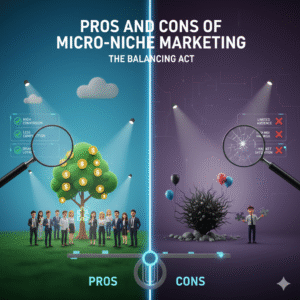
Pros and Cons of Micro-Niche Marketing
Advantages
- Easier to rank in Google
- Builds loyal audience trust
- Higher conversion rates
- Easier to create specific content that connects
Disadvantages
- Smaller audience per topic
- Requires consistent posting
- Can take time to expand into related niches
But here’s the truth: once your site ranks in one micro-niche, expanding is easy. You’ll already have authority, trust, and a proven system.

Tools That Help You Find Your Micro-Niche
- Google Trends – See what’s growing
- AnswerThePublic – Uncover questions people ask
- Jaaxy – Find low-competition keywords
- Flippa – Research what types of sites sell well
- Wealthy Affiliate – Learn keyword research, SEO, and affiliate setup step-by-step
(Tip: If you’re new to affiliate marketing, Wealthy Affiliate’s free starter plan is a solid way to get hands-on training and hosting all in one place.)
How To Stand Out in a Micro-Niche
- Focus on helpful content, not hype.
- Write for one clear reader, not everyone.
- Build trust through honest reviews.
- Use consistent visuals and tone — become a recognizable brand.
- Keep testing new affiliate offers and tracking conversions.
Comparison: Wealthy Affiliate vs ShareASale
| Feature | Wealthy Affiliate (Free Starter) | ShareASale (Affiliate Network) |
|---|---|---|
| Best for | Beginners who want training, hosting, and community in one place. | Publishers with a site who want lots of merchant options. |
| What you get | Step-by-step lessons, managed WP hosting, keyword tools, active community, support. | Access to thousands of affiliate programs; each merchant provides creatives & terms. |
| Ease of start | Very easy—build a site and learn as you go. | Moderate—apply to merchants, wait for approvals, learn each program’s rules. |
| Hosting & tools | Included (website builder, SSL, support). | Not included—bring your own hosting and tools. |
| Training & support | Guided courses, community Q&A, and help when stuck. | Limited training; support varies by merchant/network policies. |
| Payout style | WA’s own affiliate program pays recurring commissions on upgrades. | Varies by merchant (commission %, cookie length, EPC, thresholds). |
| Pros | All-in-one start, beginner-friendly, clear next steps. | Huge merchant variety, strong reporting, scalable once set up. |
| Cons | Not a multi-merchant marketplace—you still pick offers for your niche. | No hosting/training; approvals and rules differ by merchant. |
Note: ShareASale terms (commission, cookie, payout threshold) vary by merchant—always check each program’s page before you apply.
Your Next Micro-Niche Moves
- Pick one tight audience and one real pain point. Speak directly to them.
- Target long-tail searches people type right before they buy.
- Publish helpful pieces: how-tos, comparisons, and honest pros/cons.
- Link smart. Add one clear CTA and a small freebie that matches the niche.
- Track clicks, EPC, and conversions. Keep what works. Cut what doesn’t.
Final thought: Small niche, big results. Go small, win big. Publish one helpful post this week and track one number. Progress beats perfection.
5 Micro-Niche Moves to Grow Affiliate Income
Start Free and Build Smart
Ready to put these micro-niche strategies to work? Get training, hosting, and tools in one place—plus a community that helps you ship faster.
Try Wealthy Affiliate (Free Starter).
Thank You For Stopping By
If you liked my blog, please comment, leave questions below, and share.
Thank You For Stopping By
Till the next time
Elke
😀
Thank you for this information! I was unfamiliar with the concept of micro-niche! If your main niche is baby items, after reading this, I think that one could get more specific with an idea such as baby strollers. What are your thoughts on this? Do you utilize different micro niche’s within one website or create a new website for each?
The most significant distinction is that your website serves as the heart and soul of your online presence. The difference between these two is that a microsite is a website that serves a specific function. While your website may draw attention to all of your products or services, your microsite may only draw attention to one or two of the most crucial aspects of what you provide. I hope this is helpful
Elke
I found your article on micro-niches very interesting as I really struggles to narrow it down when I created my first website. You had some great ideas here and by assessing each idea you helped me to see the difference between a broad niche and a very specialized one for a particular group of consumers. Do you think that it is possible to break a guitar teaching niche for women down into a smaller niche?
Thanks for this great post, very thought provoking.
Here are a few ideas I cam up with; classical guitar teaching, best way to self teach guitar, reading sheet music, guitar maintenance, electric guitar teaching, learn classic guitar, learn to play flamingo guitar, It is a hard niche to find a micro niches I hope this will help.
Elke