
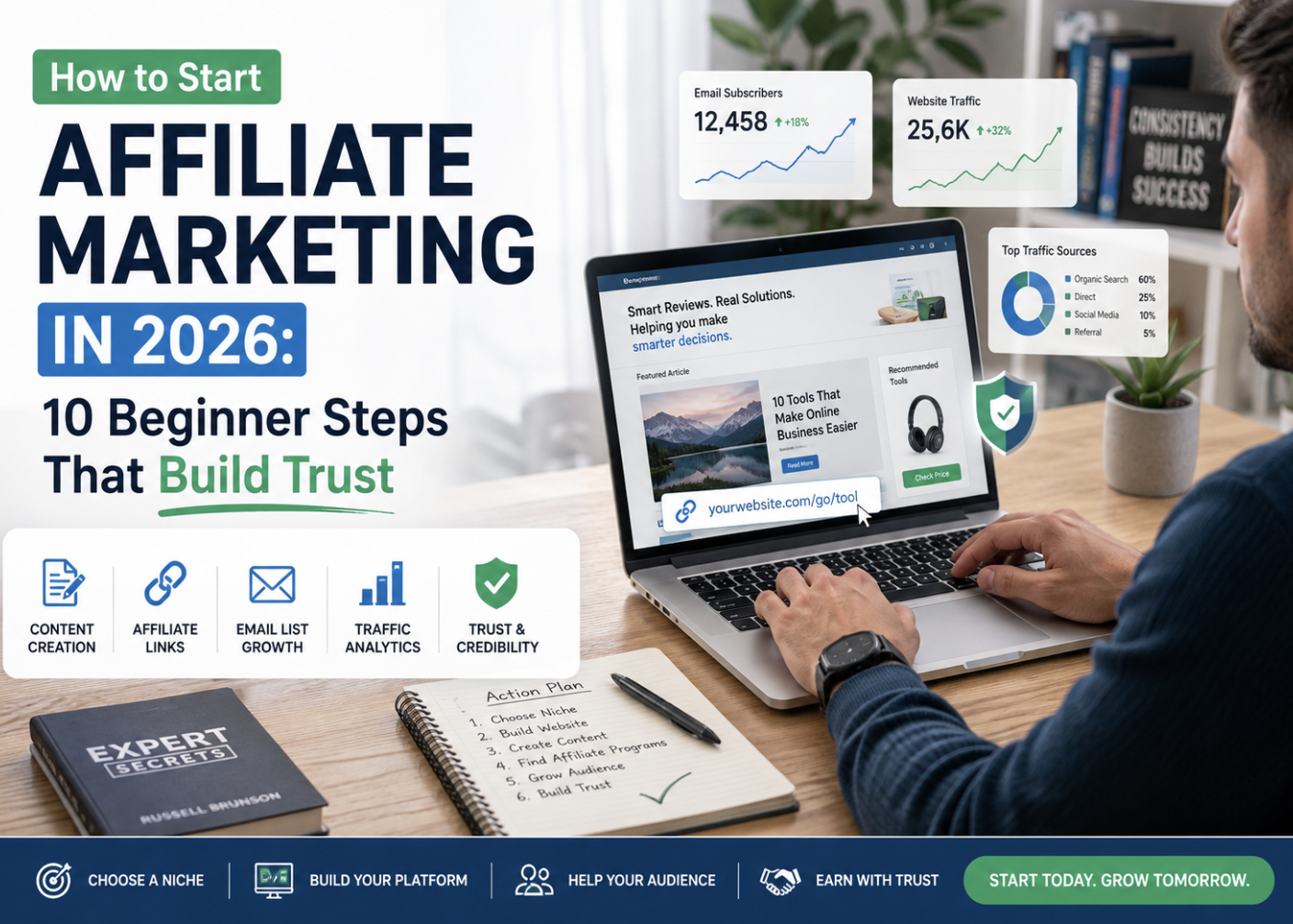
How to Start Affiliate Marketing in 2026: 10 Beginner Steps That Build Trust
We may earn money or products from the companies mentioned in this post.
Affiliate marketing sounds simple when you first hear about it.
You recommend a product. Someone clicks your affiliate link. If they buy, you may receive a commission.
The basic idea really is that simple.
Building an affiliate marketing business that people trust takes more work.
You need the right audience, useful content, suitable products, steady traffic, and enough patience to give your website time to grow.
That is where many beginners get stuck.
There is so much advice online that it is easy to jump from one strategy to another. One person tells you to start a blog. Someone else says you need social media. Another tells you that paid advertising is the only way to get results.
You do not need to do everything at once.
You need a clear starting point.
In this guide, I will show you how to start affiliate marketing in 2026 using 10 practical beginner steps.
The goal is not quick money.
The goal is to build something useful, trustworthy, and capable of growing over time.

What Is Affiliate Marketing in Simple Terms?
Affiliate marketing is a business model where you recommend another company’s product or service.
You receive a special tracking link from the affiliate program.
When someone clicks your link and completes a qualifying purchase, you may receive a commission.
For example, you could run a website about blogging and recommend:
- Website hosting
- Keyword research tools
- WordPress plugins
- Email marketing platforms
- Online training
- Blogging software
You do not normally create the product yourself.
You also do not usually handle:
- Inventory
- Packaging
- Shipping
- Customer payments
- Product development
Your role is to help the right person find the right solution.
That last part matters.
Affiliate marketing should not be about covering your website with links and hoping people buy.
Your reader is looking for help.
Give them that help first.
Why Trust Matters So Much in Affiliate Marketing
A reader may arrive on your website because they have a problem.
Perhaps they want to start a website.
Maybe they are comparing two products.
They might be worried about spending money on something that does not work.
If your article immediately pushes them toward a purchase, you have not done much to earn their trust.
Instead, give them the information they need to make their own decision.
That can include:
- Who the product is for
- Who should avoid it
- What it does well
- What could be better
- How much it costs
- Possible additional costs
- Alternative products
- Your final opinion
No product is perfect.
Saying so does not weaken your affiliate review.
It often makes the review more useful.
Google currently recommends creating content primarily for people, providing original value, clearly demonstrating experience or expertise, and giving readers enough information to achieve their goal.
That fits affiliate marketing very well.
Help first.
Recommend second.
Step 1: Decide Who You Want to Help
Before choosing products, keywords, or even a website name, decide who you want to help.
This is your audience.
Trying to write for everyone usually makes your content too broad.
For example:
Very broad audience:
People who want to make money online.
Better:
People who want to learn affiliate marketing.
More specific:
Beginners who want to build their first affiliate marketing website.
The clearer your audience becomes, the easier it is to plan your content.
Ask yourself:
What problems does my audience have?
A beginner might ask:
- How does affiliate marketing work?
- Do I need a website?
- How much does it cost?
- How do I choose a niche?
- Which affiliate programs should I join?
- How do I get traffic?
- How long will it take?
- How do affiliate links work?
Those questions can become articles.
What does my audience want to achieve?
Do they want:
- Extra income?
- A long-term online business?
- A blog that earns commissions?
- More income from an existing website?
- A way to recommend products they already use?
Understanding the goal helps you create content that feels relevant instead of generic.
Step 2: Choose a Focused Affiliate Marketing Niche
Your niche is the main subject of your website.
This decision matters, but beginners sometimes make it harder than it needs to be.
You do not need to discover a secret niche.
You need a topic that has:
- People looking for information
- Problems you can help solve
- Products or services you can recommend
- Enough article ideas to keep publishing
- Enough interest for you to stay with it
Avoid niches that are too broad
For example:
Too broad: Fitness
Better: Home fitness
More focused: Home fitness for beginners over 50
The narrower version gives you a clearer audience.
It also gives you more specific article ideas.
Do not choose a niche only because it pays well
A high commission can look attractive.
But imagine writing about a subject you dislike for the next two years.
That can become difficult very quickly.
Before choosing a niche, ask:
- Can I think of at least 30 useful article ideas?
- Do people have real questions about this topic?
- Are there good products to recommend?
- Would I still want to learn about this subject next year?
- Can I explain the subject in a helpful way?
If the answers are mostly yes, the niche may be worth exploring.
Step 3: Build a Simple Website You Control
You can technically do affiliate marketing without a website.
People also use:
- YouTube
- Social media
- Podcasts
- Other content platforms
However, I still like having a website as the main home for an affiliate business.
A website gives you somewhere to publish:
- Reviews
- Comparisons
- Tutorials
- Guides
- Resource pages
- Email signup forms
- Helpful answers
You control how your content is organized.
Your first website does not need to be fancy
Keep it simple.
A beginner website should be:
- Clean
- Easy to read
- Mobile-friendly
- Easy to navigate
- Focused on one main subject
You do not need dozens of menus, animations, popups, and complicated layouts.
Make it easy for the reader to find the answer they came for.
Important pages to include
I would start with:
- Home
- About
- Contact
- Privacy Policy
- Affiliate Disclosure
- Blog or Articles
Your About page is especially useful.
Tell readers who you are, what your website helps with, and why you created it.
People want to know who is giving them advice.
Step 4: Learn Basic Keyword Research and SEO
You do not need to become an SEO expert before writing your first article.
But learning the basics early can save you a great deal of time.
Start with search intent
Search intent simply means:
What does the person actually want when they type that search into Google?
Consider these two searches:
What is affiliate marketing?
and
Wealthy Affiliate vs ClickBank
The first person wants information.
The second person is comparing options.
Those articles should not be written the same way.
Choose keywords that fit the question
Do not choose a keyword only because an SEO tool gives it a good score.
Ask:
- Does this phrase make sense?
- Would a real person search for it?
- Can I answer it properly?
- Does it match my website?
- Is the competition realistic for my site?
Keyword tools can help.
They should guide your judgment, not replace it.
Use your keyword naturally
Place the main topic where it makes sense:
- Page title
- Introduction
- Relevant heading
- Body content
- Meta description
- Image alt text when appropriate
Do not repeat the same phrase in every paragraph.
That sounds unnatural.
Use internal links
Internal links connect one SoleAffiliate article to another.
For example, if you mention how to build an email list, link to your complete email list guide.
If you mention choosing an affiliate niche, link to your detailed niche article.
Internal links give readers somewhere useful to go next.
They also help create a clearer structure between related pages on your website.

Step 5: Create Helpful Content Before You Focus on Sales
Content is the foundation of a website-based affiliate business.
That does not mean every article needs to sell something.
In fact, it should not.
Create a mix of content.
Beginner guides
Answer basic questions clearly.
Examples:
- What Is an Affiliate Link?
- What Is Affiliate Marketing?
- Do You Need a Website for Affiliate Marketing?
- How Do Affiliate Commissions Work?
How-to articles
Show readers how to complete something.
Examples:
- How to Build an Email List
- How to Choose an Affiliate Program
- How to Find Keywords
- How to Write a Product Review
Product reviews
Help someone investigate one specific product.
Cover:
- Features
- Pricing
- Pros
- Cons
- Who it suits
- Who should avoid it
- Alternatives
- Your verdict
Comparison articles
These can help someone who has already narrowed the decision to two or three options.
For example:
- Product A vs Product B
- Platform A vs Platform B
- Free Plan vs Paid Plan
Write for someone who is confused
This is one of the simplest ways to improve your writing.
Imagine your reader knows very little about the subject.
Explain it clearly.
Short sentences help.
Examples help.
Do not make readers feel as though they should already understand complicated terms.
Google’s current guidance says useful content should provide a substantial and complete answer rather than simply rewriting what other websites already say.
That is a good standard to use when you review your own articles.
Ask:
Did I actually help the reader?
Step 6: Choose Affiliate Programs Carefully
Once you have a clear audience and useful content, you can start looking at affiliate programs.
You do not need to join every program you find.
A few relevant programs are enough to begin.
Check the product first
Before thinking about commission percentages, ask:
Would I recommend this product even if the commission were smaller?
That question can tell you a lot.
Look at:
- Product quality
- Price
- Customer support
- Reputation
- Refund conditions
- Who the product is designed for
- Whether it solves the problem you are writing about
Understand the commission
Affiliate programs use different payment structures.
You may see:
- A percentage of the sale
- A fixed payment
- Recurring commissions
- Lead payments
Do not assume the highest percentage is automatically the best program.
A lower commission on a trustworthy product can be more valuable than a large commission on something readers do not want.
Read the program rules
Check:
- Where you are allowed to promote links
- Whether email promotion is permitted
- Whether paid advertising is allowed
- Payment thresholds
- Tracking terms
- Disclosure requirements
- Prohibited marketing practices
Know what you are agreeing to.
Step 7: Add Affiliate Links Naturally and Disclose Them Clearly
Affiliate links should support your content.
They should not take over the article.
Give readers enough information first.
Then offer the link when it becomes useful.
Avoid this approach
“Buy this now because it is the best!”
That tells the reader almost nothing.
A better approach
“If you want structured training, hosting, keyword research, and support in one platform, Wealthy Affiliate may be worth investigating. Read my full review first to see the pros, cons, pricing, and who I think it suits.”
Now the reader has context.
Always disclose affiliate relationships
This is important.
The FTC says affiliate marketers should clearly and conspicuously disclose their relationship with a retailer when they can earn commissions from purchases made through their links. The FTC also says that placing the disclosure close to the recommendation is better than hiding it somewhere readers may miss.
A simple disclosure can work well:
This article contains affiliate links. If you buy through one of my links, I may receive a commission at no additional cost to you.
Clear language is better than complicated legal wording.

Step 8: Start Building an Email List Early
This is one of the most useful ideas from the older Bootcamp article, and it belongs in the main beginner guide.
You do not need thousands of visitors before starting your list.
Start small.
Why build an email list?
Someone may read one article and leave.
If they join your email list, you have a way to stay connected.
You can send:
- Helpful tips
- New articles
- Updated guides
- Useful resources
- Relevant product recommendations
Give readers a reason to subscribe
You could offer something simple such as:
- Affiliate marketing checklist
- Keyword worksheet
- Website setup checklist
- Beginner content planner
- Short PDF guide
The free resource should match the article your reader is already interested in.
Do not turn every email into a sales pitch
If every message says “buy this,” subscribers will quickly stop paying attention.
Help them.
Then recommend something when it fits.

Step 9: Grow Your Traffic and Track What Works
Creating content is only part of the job.
People also need to find it.
SEO can become an important traffic source for a website, but you do not have to depend on one source forever.
Over time you may also use:
- YouTube
- Social media
- Referrals
- Other websites
Do not try to master five traffic sources during your first month.
Start with one.
Get comfortable with it.
Then add another if it makes sense.
Track more than visitor numbers
Traffic matters.
But traffic alone does not tell you whether your website is improving.
Look at:
- Which articles receive traffic
- Which keywords are gaining impressions
- Which pages readers visit next
- Which affiliate links receive clicks
- Which products convert
- Which articles need updating
- Which topics consistently perform well
Your older Bootcamp article correctly emphasized tracking what is actually working instead of guessing.
Use that information to decide what to create next.
Improve articles that show potential
Sometimes an older article is already receiving impressions but is not ranking as well as you would like.
Instead of immediately writing another article on the same subject, improve the existing one.
You might:
- Strengthen the introduction
- Answer missing questions
- Update outdated information
- Improve headings
- Add internal links
- Add an FAQ
- Improve images
- Make the recommendation clearer
- Check the title

That is often better than creating another page that competes with it.
Step 10: Stay Consistent and Give Your Business Time
This is one of the hardest parts of affiliate marketing.
Beginners often quit because they expected faster results.
You may publish an article and receive very little traffic.
You may write ten articles and still wonder whether anything is happening.
That does not automatically mean you are failing.
A website needs time to develop.
You also need time to become better at:
- Writing
- Keyword research
- SEO
- Product research
- Internal linking
- Calls to action
- Understanding your audience
Create a realistic publishing schedule
Do not promise yourself you will publish every day if you cannot maintain it.
One good article every week is better than seven rushed articles followed by two months of nothing.
Choose a pace you can maintain.
Pay attention to small wins
Your first:
- Google impression
- Website visitor
- Email subscriber
- Affiliate click
- Comment
- Commission
These may seem small.
They show that people are beginning to find and interact with your work.
10 Common Affiliate Marketing Mistakes Beginners Should Avoid
Several of these mistakes were covered across your older beginner articles. They are useful enough to keep together in one section rather than spreading them across multiple competing pages.
1. Starting too many niches
Choose one direction first.
You can expand later.
2. Expecting overnight income
Affiliate marketing is not guaranteed income.
Give yourself time to learn.
3. Choosing products only because they pay more
Commission size should never be your only reason for recommending something.
4. Copying other websites
Research competitors.
Do not copy them.
Your article should add your own explanation, research, examples, and perspective.
5. Writing only product reviews
Readers have informational questions too.
Answer them.
6. Ignoring email marketing
An email list gives interested readers a way to stay connected.
7. Changing strategy every few weeks
Constant changes make it difficult to know what is actually working.
8. Buying too many tools
Beginners can spend a lot of money on software they barely use.
Start with what you genuinely need.
9. Ignoring your existing articles
Updating good older articles can sometimes make more sense than constantly publishing new ones.
10. Giving up too early
Progress can feel slow at the beginning.
Consistency gives you enough information to learn what works.
A Simple Affiliate Marketing Beginner Checklist
Use this as a quick action plan.
Build Your Foundation
☐ Choose one audience
☐ Choose one focused niche
☐ Set up your website
☐ Create your About page
☐ Add a Contact page
☐ Add your Privacy Policy
☐ Add an Affiliate Disclosure
Build Your Content
☐ Research beginner questions
☐ Find realistic keywords
☐ Write useful informational articles
☐ Create honest reviews
☐ Publish comparisons where they help
☐ Add internal links
☐ Check articles on mobile
Set Up Monetization
☐ Research relevant affiliate programs
☐ Read the program terms
☐ Understand the product before recommending it
☐ Add links naturally
☐ Clearly disclose affiliate relationships
Build Your Audience
☐ Start an email list
☐ Create a useful free resource
☐ Send helpful emails
☐ Choose one main traffic source
☐ Add another traffic source later if needed
Improve Your Website
☐ Check which articles receive traffic
☐ Monitor affiliate clicks
☐ Update older articles
☐ Improve pages showing potential
☐ Keep publishing consistently
You do not need to complete all of this in a weekend.
Work through it one step at a time.
Affiliate Marketing Pros and Cons for Beginners
Affiliate marketing can be a flexible way to build an online business, but it also takes time, patience, and regular maintenance.
Pros
- You do not need your own product. You can earn commissions by recommending products and services created by other companies.
- Startup costs can be flexible. You can begin with a simple website and add paid tools only when they genuinely help your business.
- You can choose your niche. This gives you the freedom to build around a subject you enjoy and understand.
- Your content can keep working after publication. A useful article may continue attracting readers long after it has been published.
- You can build several valuable assets. Your website, articles, email list, and audience can all become part of your long-term business.
Cons
- Results can take time. A new website may not attract significant traffic or commissions straight away.
- Income is not guaranteed. Website visitors and affiliate-link clicks do not automatically turn into sales.
- Affiliate programs can change. Companies may change commission rates, rules, products, or even close their affiliate program.
- Competition can be strong. Popular niches may require better content, more patience, and stronger trust with your audience.
- The business still needs maintenance. Articles become outdated, links break, products change, and older content needs regular updates.
Bottom line: Affiliate marketing can be a practical business model for beginners, but it works best when you focus on helpful content, honest recommendations, and steady long-term growth rather than quick commissions.
Do You Need a Website to Start Affiliate Marketing?
No.
A website is not the only way to do affiliate marketing.
However, I think it is particularly useful for someone who wants to build a long-term content business.
Your website can become the center of everything you create.
You can connect:
- Blog posts
- Reviews
- Email signup forms
- Resources
- Comparisons
- Tutorials
- Affiliate recommendations
You are building a library instead of relying on one post that disappears down a social media feed.
How Much Does It Cost to Start Affiliate Marketing?
There is no single figure that applies to everyone.
Your costs depend on how you decide to build your business.
Possible expenses include:
- Domain name
- Website hosting
- Email marketing software
- Keyword tools
- Premium WordPress tools
- Training
- Design tools
You do not need every paid tool from day one.
Start with the basics.
Add something when you understand exactly what problem it solves.
Avoid buying software simply because another marketer says you “must” have it.
How Long Does Affiliate Marketing Take to Work?
There is no reliable timetable.
Someone starting with an established audience is in a very different position from someone launching their first website with no traffic.
Your results can depend on:
- Niche
- Competition
- Content quality
- Number of useful articles
- Website age
- Traffic sources
- Product choices
- Search visibility
- Consistency
- Experience
Be cautious when someone guarantees that you will earn a particular income within a certain number of days.
Instead, look for signs of progress.
Are impressions growing?
Are more people visiting?
Are readers clicking internal links?
Are subscribers joining your email list?
Are affiliate links receiving clicks?
Those signals can tell you much more than an arbitrary deadline.
Is Affiliate Marketing Still Worth Starting in 2026?
Affiliate marketing can still be a practical online business model when it is approached properly.
The important point is how you approach it.
Do not build your site around quick commissions.
Build it around useful information.
Google’s current guidance continues to emphasize helpful, original, people-first content rather than pages created mainly to attract search traffic.
That makes trust even more important.
Research your recommendations.
Update your articles.
Show readers the drawbacks as well as the benefits.
Explain who a product suits.
Tell them when something is probably not worth buying.
That is the kind of affiliate content I believe has the strongest long-term value.
Where Wealthy Affiliate Can Fit for a Beginner
Some beginners prefer having training, tools, websites, and support available in one place instead of putting everything together separately.
Wealthy Affiliate is one platform I cover extensively on SoleAffiliate.
It can help beginners learn areas such as:
- Choosing a niche
- Building a WordPress website
- Keyword research
- SEO
- Content creation
- Affiliate marketing
That does not mean you should join without doing your research.
Before paying for any affiliate marketing platform, check:
- Current pricing
- What is included
- Training quality
- Support
- Limitations
- Cancellation terms
- Whether it matches your goals
You can read my Wealthy Affiliate Review 2026 for my detailed look at the platform before making a decision.
Frequently Asked Questions
Is affiliate marketing good for beginners?
Yes. Affiliate marketing can be suitable for beginners because you do not need to create your own product. However, you still need to learn how to create useful content, attract the right audience, choose suitable products, and build trust.
What should I do first when starting affiliate marketing?
Start by deciding who you want to help. Then choose a focused niche based on that audience. This gives your website, content, and affiliate recommendations a clear direction.
Can I start affiliate marketing without money?
You can begin learning for free, but building your own website usually involves some basic costs such as a domain name or hosting. Beginners do not need to buy every premium tool straight away.
Do I need a website for affiliate marketing?
No. You can also use platforms such as YouTube, email, or social media. However, a website gives you a central place you control for guides, reviews, comparisons, email signups, and affiliate recommendations.
How long does affiliate marketing take to work?
There is no guaranteed timeline. Results depend on your niche, competition, content quality, traffic, products, experience, and consistency. Focus on steady progress instead of expecting fast income.
Should beginners start an email list?
Yes. Even a small email list can help you stay connected with readers, share useful content, and recommend relevant products without relying only on search engines or social media.
Final Thoughts: Build Trust Before You Chase Commissions
Learning how to start affiliate marketing does not require a complicated plan.
Start with one audience.
Choose a focused niche.
Build a simple website.
Learn basic SEO.
Create genuinely useful content.
Choose products carefully.
Be transparent about your affiliate links.
Build an email list.
Track what works.
And give yourself enough time to improve.
You will make mistakes.
Everyone does.
The important part is learning from them instead of constantly starting again.
Remember that there is a real person behind every visit, click, and email address.
Help that person first.
If your content answers their questions, saves them time, warns them about a poor choice, or helps them choose the right product, you have given them a reason to trust you.
That trust is worth far more than one quick commission.
Thank you for reading. I hope these 10 steps give you a clear and realistic way to start affiliate marketing in 2026 and build your business on the right foundation.
Kind regards,
Elke 😀