

Affiliate Niche Research: Find Untapped Opportunities
We may earn money or products from the companies mentioned in this post.
Updated August 2026
Choosing an affiliate niche is only the beginning.
The bigger question is what you will do once you find a market that interests you.
Hundreds of websites may already cover the obvious topics. That does not mean there is no room for you.
It means you need better affiliate niche research.
Good niche research helps you look beyond broad keywords and popular topics. You start looking for questions people still need answered, products that need better explanations, and smaller groups that larger websites may be ignoring.
This is where real opportunities can appear.
Instead of trying to compete with every established website in your niche, you can find areas where your content has a better chance of being useful and noticed.
In this guide, I will show you how to find content gaps, low-competition keywords, underserved audiences, and affiliate opportunities that competitors may have overlooked.
What Is Affiliate Niche Research?
Affiliate niche research is the process of studying a specific market before deciding what content to create and which opportunities to pursue.
You are not simply asking:
“Is this niche profitable?”
You are looking deeper.
You want to understand what people search for, what problems they have, what products they consider buying, and where existing websites are failing to give them useful answers.
Think of it this way.
A broad niche such as home improvement may be extremely competitive.
But inside that market could be smaller opportunities around apartment storage, home improvement for renters, low-cost renovations, tools for beginners, or solutions for older homes.
The goal is not always to discover a completely new niche.
Often, the better opportunity is finding an overlooked angle inside an established market.
Why Affiliate Niche Research Matters
Starting with a broad idea and immediately publishing articles can create problems later.
You may discover that your keywords are too competitive. Your topics may attract visitors who have no buying intent. You could also spend months writing content that established websites already cover extremely well.
Research helps you make better decisions before doing all that work.
Good affiliate niche research can help you identify:
- Topics competitors have not covered properly.
- Long-tail keywords with more specific search intent.
- Questions people repeatedly ask.
- Smaller groups with particular needs.
- Products that need clearer reviews or comparisons.
- Problems that existing content does not solve well.
- Areas where readers are closer to making a buying decision.
You are looking for the space between what people want and what existing websites currently provide.
That space is your opportunity.
Pros and Cons of Affiliate Niche Research
✓ Pros
- Finds content gaps: Helps you discover useful topics competitors may have missed.
- Targets better keywords: Makes it easier to find specific, lower-competition search terms.
- Improves audience focus: Helps you understand what readers need, search for, and may want to buy.
- Creates a stronger content plan: Gives you related topics that can support each other through internal links.
✗ Cons
- Takes time: Good research requires checking keywords, competitors, search results, and audience needs.
- Keyword tools are not perfect: Search volume and competition scores should not be treated as guarantees.
- Low competition does not always mean profit: Some topics have little competition because there is limited demand.
- Research can become excessive: Spending too long researching can delay actually creating useful content.
Start Affiliate Niche Research With Your Audience
Before looking at keywords, look at people.
Who are you trying to help?
A niche becomes much easier to understand when you stop thinking only about topics and start thinking about the person behind the search.
For example, “email marketing” is a broad subject.
But different people searching within that market may have very different needs.
A beginner blogger may want a simple email service. A small business owner may care more about automation. An affiliate marketer may need landing pages and tracking. Someone with a very small budget may only want free options.
All of these people belong to the larger email marketing market, but their problems are different.
Look for Specific Problems
Ask what your audience struggles with.
What frustrates them?
What are they trying to learn?
What are they considering buying?
What information would help them make a better decision?
The more specific the problem becomes, the easier it is to create useful content around it.
Instead of targeting:
Best email software
you might discover an opportunity around:
Best email marketing software for beginner affiliate marketers
That is much more focused.
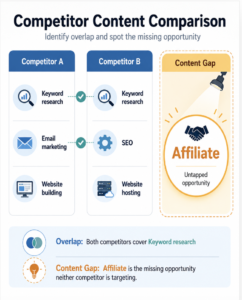
Use Affiliate Niche Research to Find Content Gaps
A content gap is a useful topic, question, or search need that your competitors have not covered well.
Finding content gaps does not necessarily mean finding something nobody has ever written about.
That is rare.
Instead, look for content that is outdated, shallow, confusing, too general, or missing important information.
Study the Websites Already Ranking
Search several important phrases connected with your niche.
Do not only look at who ranks first.
Study the type of content appearing across the first page.
Ask yourself:
Are competitors answering the search properly?
Are the articles recent?
Are important questions missing?
Do they explain both advantages and disadvantages?
Are their product comparisons actually useful?
Are beginners likely to understand the information?
Could you provide clearer examples?
Your purpose is not to copy what competitors are doing.
You are looking for what they did not do.
That difference can become your content advantage.
Find Questions Competitors Have Missed
Pay close attention to questions.
Questions tell you exactly what readers want to know.
Look at search suggestions, related searches, forums, comments, online communities, customer reviews, and discussions within your niche.
You may repeatedly see people asking the same question.
If the websites ranking in Google are not answering it properly, you may have found a valuable content gap.
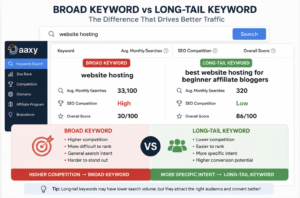
Find Keyword Gaps Instead of Chasing Big Keywords
One of the easiest mistakes in niche research is becoming obsessed with high search volume.
A keyword receiving thousands of searches can look attractive.
But if major authority websites dominate the results, it may not be the best place for a smaller affiliate site to start.
That is why niche keyword research should go beyond search volume.
Look for Long-Tail Niche Keywords
Long-tail keywords are more specific.
For example:
website hosting
is broad.
But:
best website hosting for a beginner affiliate blog
is much more specific.
The second phrase tells you far more about the reader.
You know what they need and where they are in their decision-making process.
Specific searches can also give you better article ideas because you understand the intent behind them.
Check the Search Results Yourself
Keyword tools are useful, but do not rely on a difficulty score alone.
Search the keyword.
Look at the results.
If every result comes from huge, established websites with excellent articles, ranking may be difficult.
But you may see weaker results.
Perhaps forum discussions are ranking.
Maybe older articles appear.
You might find pages that only briefly answer the question.
Those are signs worth investigating.
Affiliate niche research works best when you combine keyword data with your own examination of the search results.
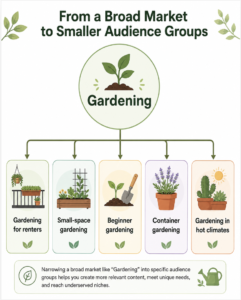
Look for Underserved Niche Markets
An underserved audience is a group whose needs are not being addressed particularly well.
This can be one of the best places to find untapped niche opportunities.
Suppose you enter the gardening niche.
Gardening alone is very broad.
But you might narrow your research to gardening for renters, gardening in small spaces, beginner gardening, low-maintenance gardens, container gardening, or gardening in hot climates.
You are still working within gardening.
You have simply identified a particular person or problem.
Do Not Make the Audience Too Small
There is a balance.
Narrowing your focus can make your website more relevant, but narrowing it too far can leave you without enough topics or products to promote.
Ask yourself whether you could realistically create dozens of useful articles around the subject.
Also consider whether people in that market buy products or services.
A good niche needs room to grow.
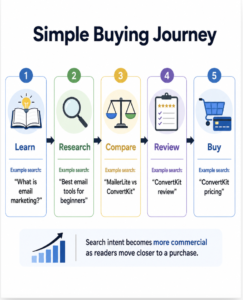
Research Buyer Intent in Your Affiliate Niche
Traffic is useful.
But affiliate marketing also depends on attracting people who sometimes buy things.
That makes buyer intent important.
Someone searching:
what is email marketing?
is probably researching.
Someone searching:
MailerLite vs ConvertKit for affiliate marketing
is much closer to choosing a product.
Both searches can be useful.
However, they serve different purposes.
A strong affiliate website normally needs informational content as well as commercially focused content.
Find Problems Connected With Products
Think about the buying journey.
Someone may first search for a solution to a problem.
Later, they may search for product recommendations.
Then they could compare two products.
Finally, they may search for a review before making a decision.
Your affiliate niche research should identify content opportunities throughout that journey.
This gives you more than random keywords.
It gives you a connected content strategy.
Analyze Competitors Without Copying Them
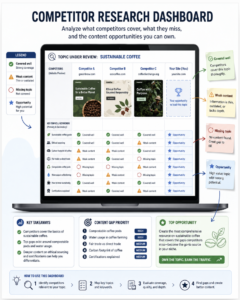
Competitor research is not about rewriting somebody else’s article.
It is about learning what already works in the market and then finding ways to provide something more useful.
Look at established websites within your niche.
Notice which topics they cover frequently.
Then pay attention to what is missing.
Examine Their Content Coverage
Suppose a competitor has written ten articles about keyword research.
You might discover that nearly all of them target advanced marketers.
There may be very little information for complete beginners.
That could be your gap.
Another website may publish dozens of product reviews but never explain who should not buy the products.
That could be another opportunity.
You do not always need more information than the competition.
Sometimes you simply need information that is clearer, more specific, or more useful to a particular reader.
Use Trends Without Chasing Every Trend
Trends can reveal new opportunities.
They can also waste your time.
Something may suddenly become popular and disappear six months later.
Before building content around a trend, ask whether it connects naturally with your niche.
Also ask whether people are likely to remain interested in the subject.
There is nothing wrong with writing timely content.
However, a strong affiliate website also needs evergreen subjects that readers may continue searching for years from now.
The best opportunities often combine a stable market with changing products, questions, and customer needs.
Validate Untapped Niche Opportunities Before Committing
Finding an interesting idea does not automatically make it a good opportunity.
Validate it first.
Search for related keywords.
Look at the competition.
Check whether businesses sell relevant products or services.
Look for affiliate programs.
See whether people discuss the problem online.
Most importantly, check whether you can find enough useful article ideas.
One promising keyword is not enough to build an entire website around.
Test the Niche With Content Ideas
Before committing heavily, brainstorm possible content.
Can you think of informational articles?
Can you create tutorials?
Are there products you could review?
Can products be compared?
Are there questions you can answer?
Can you create supporting articles around the main subject?
If you struggle to find ideas now, creating content later may become difficult.
Turn Affiliate Niche Research Into a Content Plan
Research is only useful when you do something with it.
Once you have collected your ideas, group similar topics together.
For example, you might have a main topic about email marketing for affiliate marketers.
Supporting topics could cover choosing an email platform, building a list, writing welcome emails, creating lead magnets, comparing platforms, and avoiding common mistakes.
Those articles support each other.
They also make internal linking easier because readers can naturally move from one related subject to another.
Build Topic Clusters
Try to think in groups rather than isolated articles.
One main subject can lead to several supporting subjects.
This helps you cover a niche in depth without repeatedly writing essentially the same article.
It also makes it easier to see where your website already has enough coverage and where genuine content gaps remain.
Common Affiliate Niche Research Mistakes
One mistake is choosing keywords only because a tool says they are easy.
Another is assuming low competition automatically means a good opportunity.
Sometimes competition is low because very few people care about the topic.
You also want to avoid choosing a niche only because you have been told it is profitable.
If you know nothing about the subject and have no interest in learning it, producing useful content month after month may become difficult.
Another mistake is trying to cover everything.
A new affiliate site usually does not need to compete with the largest websites in an entire industry.
Start with an area where you can provide focused, useful information.
Then expand as your website grows.
How Affiliate Niche Research Helps You Find Better Opportunities
Successful niche research is not about discovering a secret market nobody else knows exists.
It is about looking more closely than most people do.
Study the audience.
Study their problems.
Research the keywords they use.
Look at competitors.
Find missing information.
Identify underserved groups.
Then determine whether those opportunities connect with products, services, or other ways to monetize your website.
This approach gives your content a clear purpose.
You stop publishing simply because a keyword appeared in a research tool.
Instead, every article becomes part of a broader plan.
FAQ About Affiliate Niche Research
What Is Affiliate Niche Research?
Affiliate niche research is the process of studying a market, its audience, keywords, competitors, products, and content opportunities before deciding what affiliate content to create.
The goal is to find useful areas where you can serve readers without competing for every broad keyword in the market.
How Do I Find Content Gaps in My Niche?
Start by reviewing competitor websites and search results.
Look for unanswered questions, outdated information, weak articles, underserved audiences, and topics that competitors only cover briefly.
Then research related keywords to see whether people are actively searching for those subjects.
What Is a Keyword Gap?
A keyword gap is a relevant search term that competitors rank for while your website does not.
It can also reveal useful topics that websites in your niche have not covered well. Finding these gaps can give you strong ideas for new content.
How Do I Find Low-Competition Affiliate Niches?
Start with a broad market and narrow it by audience, problem, product type, or specific need.
Research relevant keywords and examine the actual Google search results. Do not rely only on keyword difficulty scores.
A good opportunity also needs enough audience interest and suitable products or services to promote.
Final Thoughts on Affiliate Niche Research
Affiliate niche research is not about finding a magical keyword or a secret niche.
It is about understanding your market better.
Look for the questions people still need answered.
Find content gaps.
Research long-tail niche keywords.
Study competitors without copying them.
Pay attention to underserved audiences and buyer intent.
Then turn what you learn into useful content.
You do not need to be the biggest website in your market.
You need to give the right reader a good reason to choose your content.
That is where careful affiliate niche research can make a real difference.
Ready to Find Better Affiliate Opportunities?
Affiliate niche research can help you make smarter decisions before you spend hours creating content.
Start by looking for:
- Keywords with clear search intent
- Content gaps your competitors have missed
- Questions your audience still needs answered
- Niche opportunities with real buying potential
If you want a simple way to research keywords and competition, try Jaaxy for free and see what opportunities you can uncover.
The right opportunity is not always the biggest one. Sometimes the best results come from finding a smaller gap and serving that audience better than anyone else.
Elke