

How To Write An Affiliate Product Review: 9 Steps That Build Trust
We may earn money or products from the companies mentioned in this post.
Upated on the August 2026
How To Write An Affiliate Product Review: 9 Steps That Build Trust
Writing an affiliate product review is not about telling readers that everything is wonderful.
Your job is to help someone make a decision.
That means answering the questions they may have before spending their money.
Is the product worth the price?
Who is it best for?
What does it do well?
Where does it fall short?
Are there better alternatives?
A strong affiliate product review answers these questions without sounding like one long sales pitch.
Trust matters.
If readers believe you are giving them a fair assessment, they are more likely to pay attention to your recommendation.
Google’s own guidance for high-quality reviews recommends evaluating products from the user’s point of view, showing knowledge of the product, providing evidence of experience, explaining what makes it different, and discussing both benefits and drawbacks.
Here are nine practical steps you can follow when learning how to write an affiliate product review.

1. Understand What Your Reader Wants to Know
Before writing about the product, think about the person searching for the review.
Someone reading a product review is usually further along in the buying process.
They already know the product exists.
Now they are trying to decide whether it is right for them.
Ask yourself:
- What problem are they trying to solve?
- Why are they considering this product?
- What might stop them from buying?
- What information would make the decision easier?
- What alternatives might they also be considering?
Your review should answer those questions.
Match the Search Intent
Suppose someone searches:
“Wealthy Affiliate review”
They probably do not want a general explanation of affiliate marketing.
They want to know things such as:
- What Wealthy Affiliate includes.
- What it costs.
- Whether beginners can use it.
- What the training is like.
- What the drawbacks are.
- Whether it is worth joining.
Stay focused on that intent.
Do not make readers search through several unrelated sections to find the answer they came for.

2. Research the Product Before You Recommend It
Good affiliate reviews need research.
Do not rewrite the sales page.
The company already has a sales page.
Your review needs to add something different.
Start with the official product information.
Check:
- Features.
- Pricing.
- Plans.
- Refund policies.
- Support options.
- Requirements.
- Important limitations.
- Recent changes.
Then look deeper.
If possible, use the product yourself.
Take screenshots.
Explore the dashboard.
Try the main features.
Check whether the product actually does what the company says it does.
Separate Facts From Opinions
There is nothing wrong with giving your opinion.
That is part of a review.
But make the difference clear.
For example:
Fact: The platform includes website hosting.
Opinion: I like having hosting included because it means I do not need to manage another service.
That makes your review easier to trust.
3. Start With a Clear Introduction and Quick Verdict
Do not make readers wait until the bottom of a 3,000-word article to discover what you think.
Give them some direction early.
Your introduction should explain:
- What you are reviewing.
- Who the product is designed for.
- What problem it aims to solve.
- What your review will cover.
Then give a brief first impression.
For example:
Wealthy Affiliate provides training, website hosting, research tools, and support for people who want to build an affiliate marketing business. I think it is best suited to beginners who want several important tools in one place, although it will not suit everyone.
That does not give away the whole review.
It simply helps readers understand where you are heading.
Avoid Dramatic Openings
You do not need:
“This shocking system changed everything!”
Or:
“You won’t believe what I discovered!”
A clear introduction is stronger than hype.
4. Explain What the Product Is and Who It Is For
Readers need context before you start discussing individual features.
Give them a simple product overview.
You could include:
- Product name.
- Company or creator.
- Product type.
- Price.
- Free trial, if available.
- Main purpose.
- Intended user.
- Your overall rating, if you use ratings.
Keep this section easy to scan.
Tell Readers Who Will Benefit Most
This is one of the most useful parts of an affiliate product review.
Explain who the product suits.
For example:
This may suit you if:
- You are a beginner.
- You want structured training.
- You prefer several tools in one platform.
- You want support while learning.
Then explain who may not need it.
It may not suit you if:
- You already have advanced experience.
- You already pay for tools you prefer.
- You only need one specific feature.
- The ongoing price does not fit your budget.
You are not trying to make every reader buy.
You are helping the right reader decide.

5. Turn Product Features Into Real Benefits
A list of features is useful.
But features alone rarely explain why someone should care.
Good affiliate review writing connects each important feature with a benefit.
For example:
Feature: Keyword research tool.
Benefit: It can help you find topics people are searching for before you spend hours writing an article.
Another example:
Feature: Website hosting included.
Benefit: You may not need to buy a separate hosting plan to get your website online.
Keep asking one question:
What does this feature actually do for the user?
Do Not Cover Every Tiny Feature
Focus on what affects the buying decision.
Readers usually care more about five important features than twenty minor ones.
For each major feature, explain:
- What it does.
- Why it matters.
- How well it works.
- Any limitation you noticed.
That gives readers information they can actually use.

6. Add Evidence and Personal Experience
This is where your review can become much stronger than generic content.
If you have used the product, show it.
You could include:
- Your screenshots.
- Your results.
- Examples.
- What you found easy.
- What confused you.
- What changed after using it.
- Features you use regularly.
- Features you rarely use.
Google specifically recommends providing evidence of your own experience where possible because it helps demonstrate knowledge and authenticity.
Be Precise About Your Experience
Instead of:
“The training is excellent.”
Explain why.
For example:
I found the beginner training easy to follow because the lessons were arranged in order. I did not have to work out which lesson to complete next.
That tells the reader something.
Another example:
Instead of:
“The keyword tool is amazing.”
Try:
I find the keyword tool useful when I want to check several possible article ideas before choosing which one to write.
Specific examples are more believable than praise.
Never Pretend You Used Something You Did Not Use
If you have not personally tested a feature, say so.
You could write:
I have not personally used this feature, so I am basing this section on the information provided by the company.
That is far better than pretending.
Trust is difficult to build and very easy to lose.
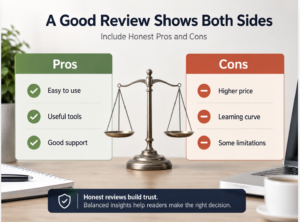
7. Include Honest Pros and Cons
Every meaningful affiliate product review should discuss both advantages and disadvantages.
No product is perfect.
If your entire review sounds positive, readers may start questioning whether the review exists only to earn a commission.
Keep Your Pros Specific
Instead of:
- Excellent.
- Fantastic.
- Amazing support.
Write:
- Beginner training follows a clear sequence.
- Website hosting is included.
- Support is available inside the platform.
- Several affiliate marketing tools are available in one account.
Specific information is more useful.
Make the Cons Meaningful
Do not write fake disadvantages such as:
“There are so many great features that it may be overwhelming.”
If there is a genuine weakness, explain it.
Possible drawbacks might involve:
- Price.
- Learning curve.
- Limited features.
- Renewal costs.
- Complicated setup.
- Missing integrations.
- Restrictions on lower-priced plans.
Then explain how important each drawback really is.
A disadvantage may be serious for one reader but irrelevant to another.
Examples of Useful Pros
- Easy to use: Beginners can understand the main features without a steep learning curve.
- Useful features: The product includes tools that solve a real problem for the user.
- Reliable support: Help is available when customers need assistance.
- Good value: The features and benefits justify the price for the right user.
Examples of Meaningful Cons
- Higher price: The cost may be too high for beginners or people on a tight budget.
- Learning curve: Some features may take time to understand.
- Feature limitations: Certain tools or functions may only be available on higher-priced plans.
- Not right for everyone: Experienced users may already have tools that better suit their needs.
8. Discuss Price, Value, and Alternatives
Readers eventually want to know:
Is this worth paying for?
Do not just list the price.
Explain what the reader receives for that money.
Ask:
- What is included?
- Is there a free version?
- Is there a trial?
- Does the price increase?
- Are extra tools required?
- Are there additional charges?
- How does the price compare with alternatives?
Price and value are not the same thing.
A cheaper product can be poor value.
A more expensive product can be good value if it replaces several other services.
Mention Alternatives When They Are Relevant
Your reader may already be comparing products.
You can help by briefly explaining the differences.
For example:
If you mainly need hosting, a dedicated hosting provider may be a better fit. If you need training, hosting, research tools, and community support together, an all-in-one platform may offer better value.
You do not need to turn every review into a giant comparison article.
Mention the closest alternatives and explain the main difference.
Google’s review guidance also recommends explaining what separates a product from competitors and which option may be better for different circumstances.
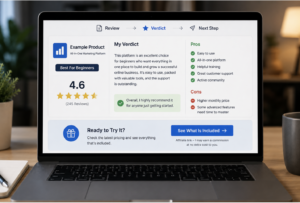
9. Give a Clear Verdict and Next Step
By the end of your review, the reader should know exactly what you think.
Do not suddenly become vague.
Summarize:
- What the product does well.
- Its biggest weakness.
- Who you recommend it for.
- Who should probably choose something else.
- Whether you believe it offers reasonable value.
A verdict could sound like this:
I think this platform is a good choice for beginners who want training and website tools in one place. It is less attractive for experienced marketers who already have their own hosting, keyword tools, and established workflow.
That is much stronger than:
“Overall, this is an amazing product and I highly recommend it.”
Give Readers a Natural Call to Action
If you recommend the product, tell readers what they can do next.
For example:
Want to see what is included? Visit the official website to compare the plans and decide whether it fits what you need.
Button text could be:
See What Is Included
Or:
Visit the Official Website
Or:
Check the Current Plans
Make the action clear.
Do not create unnecessary urgency.
Be Clear About Affiliate Links
If you may earn money when someone buys through your link, tell the reader.
Transparency is part of building trust.
For example:
This article contains affiliate links. If you make a purchase through one of these links, I may earn a commission at no extra cost to you.
Place the disclosure somewhere readers can easily notice it rather than hiding it at the very bottom.
For U.S. audiences, FTC guidance says affiliate relationships should be disclosed clearly and conspicuously, with the disclosure close enough to the recommendation or link that readers understand the connection.
Rules can vary by location, so make sure your disclosures also comply with the requirements that apply to your business and audience.
A Simple Affiliate Product Review Structure You Can Follow
You do not have to reinvent your review structure every time.
Here is a simple format.
H1: Product Name Review
Start with a short introduction.
Then include:
Quick Verdict
Give the reader your overall impression.
Product Overview
Include:
- Product name.
- Company.
- Price.
- Purpose.
- Best suited for.
- Rating, if used.
Who Is This Product For?
Explain who is likely to benefit.
Main Features and Benefits
Focus on the features that matter most.
My Experience
Add your own observations and evidence where possible.
Pros and Cons
Keep them specific and balanced.
Pricing and Value
Explain what readers receive for their money.
Alternatives
Mention relevant choices when useful.
Final Verdict
Explain whether you recommend it and why.
Call to Action
Give the reader a clear next step.
This structure works because it follows the questions a potential buyer naturally asks.
Common Affiliate Product Review Mistakes
A review can contain plenty of information and still fail to help the reader.
Here are several mistakes I would avoid.
Copying the Company’s Sales Page
Your reader can already visit the company website.
Give them information they cannot get from the sales copy alone.
Add your observations.
Using Too Much Hype
Repeatedly calling something amazing or revolutionary does not make your review more convincing.
Explain why something is useful instead.
Hiding the Drawbacks
A balanced review is more valuable than a perfect-looking review.
Readers expect products to have weaknesses.
Making Unsupported Claims
Do not promise results that you cannot prove.
Be particularly careful with claims about income, performance, health, or guaranteed outcomes.
Writing for Google Instead of the Reader
Your main keyword matters.
But it should fit naturally.
Google’s Search Essentials recommends creating helpful, reliable, people-first content and using the words people actually search for in important locations such as the title and main heading.
That is why the main keyword for this article is:
how to write an affiliate product review
Use it where it makes sense.
Do not repeat it in every paragraph.
How Long Should an Affiliate Product Review Be?
There is no perfect word count.
Your review should be long enough to answer the reader’s important questions.
Some products need detailed explanations.
Others do not.
Do not add another 1,000 words simply because another review ranks above yours.
Quality is more important than padding.
Google’s review guidance specifically emphasizes the quality and originality of reviews rather than writing to a particular length.
Should You Use Images in an Affiliate Review?
Yes, when the images add useful information.
Good choices include:
- Your own screenshots.
- Dashboard images.
- Before-and-after examples.
- Pricing comparisons.
- Feature demonstrations.
- Charts.
- Product photographs.
- Simple comparison graphics.
Images can help prove that you actually examined or used the product.
They also break up long sections of text.
Do not add images just to fill space.
Every image should have a reason to be there.
Frequently Asked Questions About Affiliate Product Reviews
What Is an Affiliate Product Review?
An affiliate product review evaluates a product or service and may include affiliate links that allow the writer to earn a commission if a reader makes a purchase. A good review should help the reader make an informed decision rather than simply push for a sale.
Do I Need to Own a Product Before Reviewing It?
Personal experience is very valuable because it gives you more useful information to share. If you have not used the product yourself, be honest about that and never claim experience you do not have.
Should I Include Negative Points in My Review?
Yes. Meaningful disadvantages help readers decide whether a product fits their needs. Including genuine drawbacks also makes your affiliate product review more balanced and trustworthy.
How Many Affiliate Links Should I Add?
There is no perfect number. Add affiliate links where they are useful and where the reader has enough information to decide whether they want to learn more. More links do not automatically mean more sales.
A Simple Affiliate Product Review Structure
Follow this simple structure to create a review that is clear, balanced, and easy for readers to follow.
Give readers your overall impression early.
Include the product name, company, price, purpose, best user, and rating if you use one.
Explain who is most likely to benefit and who may be better choosing something else.
Focus on the features that matter most and explain how they help the user.
Add screenshots, examples, results, and your own observations where possible.
Give readers a balanced view with genuine strengths and weaknesses.
Explain what readers receive for their money and whether the price makes sense.
Mention useful alternatives, then clearly explain whether you recommend the product and why.
Give readers one clear next step, such as checking the current plans, reading a comparison, or visiting the official website.
Final Thoughts: Trust Comes Before the Commission
Learning how to write an affiliate product review comes down to one principle.
Help the reader make the right decision.
Research the product.
Explain what it does.
Show how the important features affect the user.
Share genuine experience when you have it.
Discuss the advantages.
Discuss the weaknesses.
Explain the price and alternatives.
Then give your verdict.
Some readers will buy.
Others will decide the product is not right for them.
Both outcomes are acceptable.
A trustworthy affiliate website should help readers make better decisions, not simply chase every possible commission.
Build that trust consistently, and your reviews can become useful resources that readers return to when they need help choosing what to buy.
I hope How To Write An Affiliate Product Review: 9 Steps That Build Trust helps you write affiliate product reviews that are clear, honest, and genuinely useful to your readers.
Wishing you every success,
Elke