
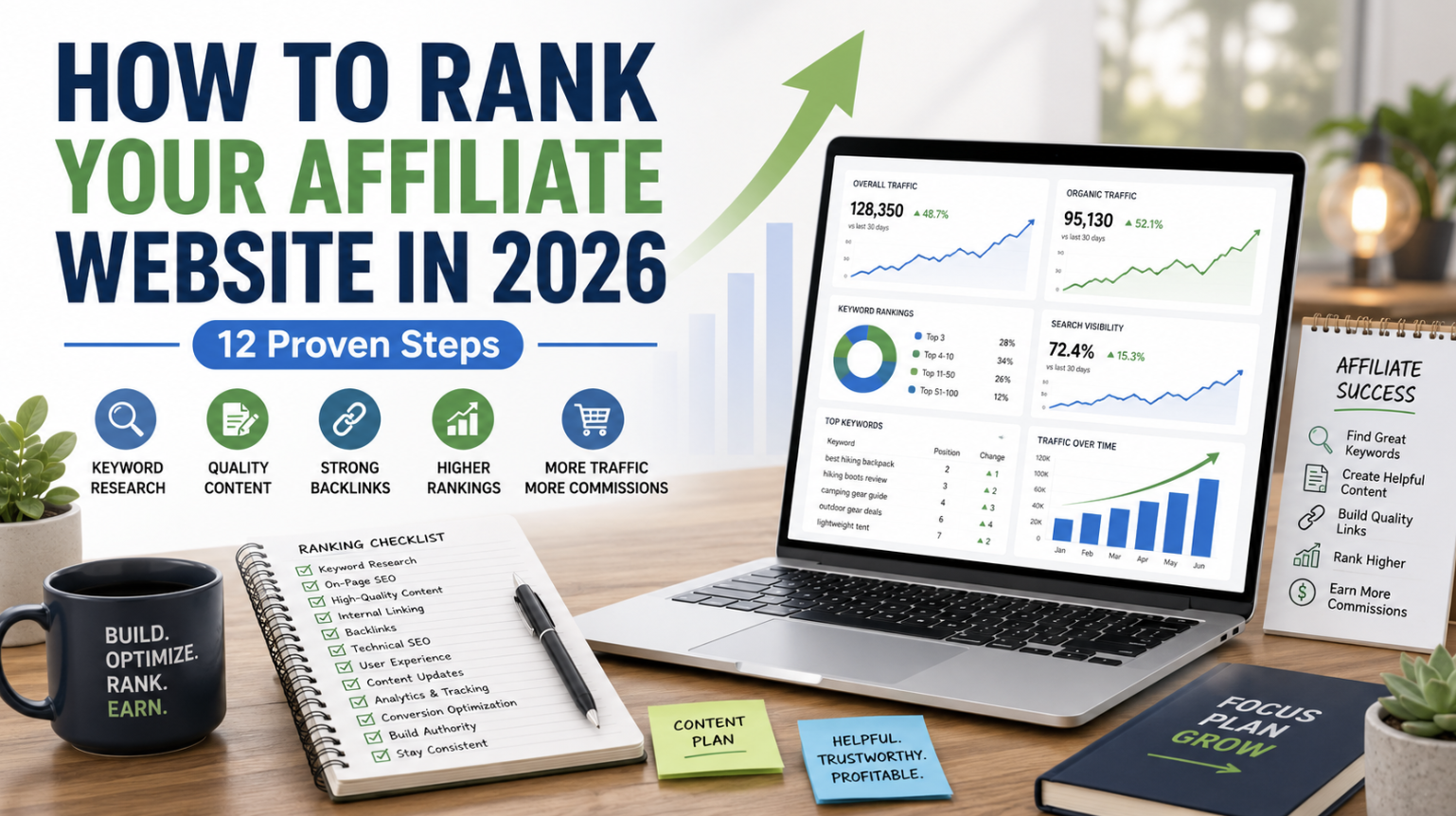
How To Rank Your Affiliate Website In 2026 (12 Proven Steps)
We may earn money or products from the companies mentioned in this post.
Updated September 2026
Building an affiliate website is only the beginning.
The harder part is getting people to find it.
You can publish useful reviews, comparison articles, tutorials, and buyer guides, but if those pages never appear where people are searching, your chances of earning consistent affiliate income remain limited.
That is why learning how to rank your affiliate website matters.
SEO in 2026 is not about repeating the same keyword dozens of times or publishing hundreds of similar articles.
Google continues to emphasize helpful, reliable, people-first content. It also warns against creating large amounts of low-value or repetitive content simply to target different search phrases.
For affiliate websites, that means quality matters more than simply increasing your post count.
Your site needs clear topics, useful content, good internal links, trustworthy product recommendations, strong page performance, and a structure that makes sense to both readers and search engines.
In this guide, I will show you how to rank your affiliate website in 2026 using 12 practical steps.
Step 1: Match Every Article to Clear Search Intent
Before changing titles, adding keywords, or adjusting links, ask one question:
What does the person searching for this topic actually want?
This is search intent.
A person searching for:
What is an affiliate link?
probably wants a simple explanation.
Someone searching:
Wealthy Affiliate vs Authority Hacker
is much closer to comparing products.
Those two readers need very different articles.
Common Search Intent Types
- Informational — the reader wants to learn something
- Commercial — the reader is researching products or services
- Comparison — the reader is choosing between options
- Transactional — the reader may be ready to act or purchase
- Navigational — the reader wants a particular website, brand, or page
Your article should satisfy the intent behind the search rather than simply contain the keyword.
If someone searches for a product comparison and lands on a general beginner guide, they may leave because the page does not answer the question they asked.
That hurts the reader experience.
Check the Search Results Before Writing
Search your main topic and look at the types of pages already appearing.
Ask:
- Are they tutorials?
- Are they product reviews?
- Are they comparison pages?
- Are they lists?
- Are they beginner guides?
- Are they short answers or detailed guides?
You are not trying to copy those pages.
You are trying to understand what type of answer people appear to want.
Then create something more useful.
Step 2: Stop Your Own Articles From Competing With Each Other
One of the biggest problems on an older affiliate website is not always competition from another website.
Sometimes you are competing with yourself.
This can happen when several articles cover nearly the same search intent.
For example, you may have:
- How to Start Affiliate Marketing
- Affiliate Marketing for Beginners
- Beginner Affiliate Marketing Guide
- How Affiliate Marketing Works
- Affiliate Marketing Step-by-Step
If all five pages answer essentially the same question, Google has to decide which one represents your site best.
That is why auditing older content is so important.
Give Each Article One Clear Job
Before publishing another post, ask:
Do I already have an article that answers this question?
If the answer is yes, improving the existing article may be better than creating another one.
You can also:
- Merge weak overlapping articles
- Redirect outdated versions
- Change the search intent of one article
- Strengthen one main page and support it with narrower articles
- Remove duplicate sections from related posts
A smaller group of strong, clearly separated articles is often easier to manage than dozens of posts covering the same ground.
Step 3: Optimize the Page Title, H1, URL, and Meta Description
Your page should make its subject obvious.
That does not mean stuffing the primary keyword everywhere.
It means using clear language.
For this article, the primary keyword is:
how to rank your affiliate website
That phrase fits naturally in the H1 and introduction because it describes exactly what the article covers.
Keep the Main SEO Elements Clear
Your page should normally have:
- One clear H1
- A short descriptive URL
- A title that matches the page
- A useful meta description
- H2 and H3 headings that organize the content
- Natural use of related phrases
Avoid titles that sound awkward simply because an SEO tool suggested a phrase.
A title still needs to make sense to a real person.
Do Not Force Exact Keywords Everywhere
Google has become much better at understanding the meaning of a page.
You do not need to repeat an exact phrase in every heading.
Use related language naturally.
For example:
- affiliate website rankings
- affiliate SEO
- organic traffic
- rank affiliate content
- improve Google visibility
That keeps your writing readable while staying focused on the topic.
Step 4: Publish Content That Adds Something Useful
Google’s current guidance continues to emphasize content created primarily for people rather than content created mainly to manipulate rankings.
That matters especially for affiliate websites.
Affiliate content can become thin very quickly when it simply repeats information from a merchant’s website.
A useful affiliate page should add something.
That might include:
- Your own experience
- Clear explanations
- Screenshots
- Product comparisons
- Pros and cons
- Examples
- Pricing observations
- Who the product suits
- Who should avoid it
- Alternatives
- Real questions readers are likely to ask
Google’s spam guidance specifically warns against thin affiliate pages that copy product descriptions without adding meaningful value.
Do Not Publish Just to Hit a Word Count
There is no magic article length.
A 1,200-word article that answers the question properly can be better than a 4,000-word article filled with repetition.
Write enough to solve the reader’s problem.
Then stop.
Step 5: Make Product Reviews More Original
Product reviews are an important part of many affiliate websites.
They are also an area where quality matters greatly.
Google recommends that reviews demonstrate knowledge, provide useful evidence, explain advantages and disadvantages, compare alternatives, and help readers understand what sets a product apart.
That means a good review should go beyond listing features.
Strengthen Affiliate Reviews With Evidence
Where appropriate, include:
- Screenshots you created
- Your own observations
- Your experience using the platform
- Examples of features
- Advantages and disadvantages
- Pricing information
- Comparisons with alternatives
- Who the product suits
- Who should look elsewhere
- Your final recommendation
If you have used a product for several years, say so.
That experience is useful.
Avoid Making Every Product Sound Perfect
Readers know that products have weaknesses.
If every review says everything is excellent, your recommendations can become difficult to trust.
Balanced reviews are more helpful.
Explain what you like and what you do not.
Step 6: Build Strong Internal Links Between Related Articles
Internal links help readers discover more useful information.
They also help Google understand how your pages relate to one another.
Google recommends descriptive, relevant anchor text and says important pages should have internal links pointing to them.
Use Descriptive Anchor Text
Avoid vague wording such as:
click here
Instead, use text that explains where the reader is going.
For example:
how to choose profitable affiliate keywords
is clearer than:
read more here
Link Only When It Helps
Do not add an internal link simply because a plugin recommends one.
Ask whether the linked article genuinely helps the reader continue learning about the subject.
Good internal links might connect:
- A beginner guide to a detailed keyword article
- A product review to a comparison
- A niche article to an audience guide
- A content article to an SEO guide
- An affiliate program article to a relevant review
You do not need dozens of links in every post.
Use the most relevant ones.
Step 7: Make Sure Google Can Crawl and Index the Right Pages
A strong article cannot rank if Google cannot properly access or index it.
Google Search Console should therefore be part of your regular SEO routine.
Use it to check whether important pages are indexed and whether Google is encountering problems.
Check New and Updated URLs
After making a major update, look at the page in Search Console.
Check:
- Is the URL indexed?
- Can Google crawl the page?
- Is the canonical URL correct?
- Is the page accidentally marked noindex?
- Is the page blocked?
- Is the sitemap finding the URL?
Google says Search Console can help site owners monitor crawling, indexing, search performance, and page-level issues.
Redirect Old URLs Properly
When you change an old slug, do not simply abandon the old URL.
Redirect it to the new page.
This is especially important during an audit when older articles are receiving new titles and cleaner URLs.
Step 8: Improve Speed and Overall Page Experience
A useful article should also be pleasant to use.
Google recommends looking at overall page experience rather than chasing one perfect technical score.
Important areas include:
- Mobile usability
- Secure HTTPS
- Page speed
- Stable layouts
- Clear main content
- Reasonable advertising
- Avoiding intrusive popups
Core Web Vitals in 2026
Google’s current Core Web Vitals guidance uses these targets:
- LCP within 2.5 seconds
- INP below 200 milliseconds
- CLS below 0.1
These metrics measure loading performance, responsiveness, and visual stability.
You do not need to become obsessed with achieving a perfect score.
Focus on obvious problems.
Simple Ways to Improve Page Performance
- Compress large images
- Remove plugins you no longer use
- Avoid unnecessary animations
- Reduce heavy scripts
- Use caching
- Keep your theme lightweight
- Test important pages on mobile
- Avoid oversized popups
A fast page will not magically rank number one.
But a slow, frustrating website can make it harder to keep visitors engaged.
Step 9: Optimize Images Without Keyword Stuffing
Images can support SEO when they genuinely help the article.
Google recommends descriptive filenames and useful alt text that explains the subject of the image.
Rename Images Before Uploading
Instead of:
IMG4837.jpg
use something descriptive such as:
affiliate-website-seo-strategy.jpg
Write Useful Alt Text
Alt text should describe the image.
For example:
Affiliate website SEO dashboard showing organic traffic growth
is much more useful than:
affiliate SEO affiliate website best affiliate SEO rank Google affiliate marketing
The second version is keyword stuffing.
Place Images Near Relevant Content
If you add an image explaining internal linking, place it near your internal-linking section.
The surrounding content helps provide context.
Use images to make the article easier to understand, not simply to make the page longer.
Step 10: Handle Affiliate Links Correctly and Build Trust
Affiliate links themselves are not a reason your site cannot rank.
Poor affiliate content is the bigger problem.
Google’s current guidance says affiliate links are acceptable when the content adds genuine value. It also recommends qualifying paid or commercial links appropriately.
Use Sponsored Attributes
Affiliate links should normally be marked:
rel="sponsored"
Google states that nofollow is still accepted for paid links, but sponsored is preferred.
Make Your Affiliate Relationship Clear
Readers should also know when you may receive a commission.
A simple disclosure can say:
This article contains affiliate links. If you purchase through one of my links, I may earn a commission at no additional cost to you.
Trust matters.
So do:
- Clear author information
- An About page
- Contact information
- Privacy information
- Affiliate disclosures
- Honest reviews
- Credible external sources
Do not hide the commercial purpose of the page.
Step 11: Build Authority by Improving What You Already Have
You do not always need more articles.
Sometimes the best SEO opportunity is already sitting on your website.
Look at older pages receiving:
- Impressions but few clicks
- Rankings near page one
- Traffic that has declined
- Outdated screenshots
- Old product information
- Broken links
- Weak introductions
- Poor internal links
These pages may be easier to improve than starting another article from zero.
Update With a Purpose
Do not change a date from 2024 to 2026 without actually improving the article.
Google explicitly warns against changing dates simply to make pages appear fresh when the content has not been substantially updated.
A real update might include:
- New information
- Better examples
- Updated screenshots
- Stronger comparisons
- Removed outdated sections
- Better internal links
- Improved headings
- Corrected facts
- Updated products
- Current sources
Earn Links Rather Than Buying Them
Useful original resources have a better chance of attracting natural links.
Consider creating:
- Detailed tutorials
- Original comparisons
- Checklists
- Case studies
- Useful tables
- Real screenshots
- First-hand reviews
- Research summaries
Avoid buying links, automated link-building schemes, or excessive exchanges designed only to influence rankings. Google’s current spam policies continue to prohibit manipulative link schemes.
Step 12: Measure What Google Is Actually Showing
Once you know how to rank your affiliate website, you still need to measure what is happening.
Do not rely only on an SEO plugin score.
Use real data.
Use Google Search Console
Look at:
- Impressions
- Clicks
- Search queries
- Landing pages
- Countries
- Devices
- Average position trends
Search Console shows what is happening before people reach your site.
Google Analytics can then help you understand what visitors do after arriving. Google describes Search Console as the primary source for Search performance data and Analytics as the source for on-site behavior.
Watch AI Search Visibility in 2026
Search has changed.
Google now includes AI-powered search experiences such as AI Overviews and AI Mode.
In 2026, Google introduced dedicated Search Console reporting for visibility within generative AI features. According to Google, those reports were rolled out worldwide by August 31, 2026.
This gives website owners another area to watch alongside traditional search results.
Google’s guidance for AI search remains familiar: create useful content for people, use quality images and video where appropriate, and avoid creating separate low-value pages for every possible variation of a query.
That means you do not need a completely separate “AI SEO” website strategy.
You need stronger content.
What Should You Track Each Month?
You do not need to check rankings every hour.
A monthly review is enough for many established articles.
Look for:
- Pages gaining impressions
- Pages losing clicks
- Queries moving closer to page one
- Articles with high impressions but weak click-through rates
- Pages that are no longer indexed
- New AI search visibility
- Articles generating affiliate clicks
- Articles receiving traffic but producing no conversions
This helps you decide what to work on next.
SEO Mistakes That Can Hold an Affiliate Website Back
Ranking problems are not always caused by one major mistake.
Often several smaller issues build up.
Watch for:
- Several articles targeting the same intent
- Thin product reviews
- Copying merchant descriptions
- Publishing content only to hit keywords
- Keyword stuffing
- Old product information
- Broken internal links
- Poor mobile layouts
- Slow pages
- Weak titles
- Missing affiliate disclosures
- No original experience
- Publishing dozens of near-identical AI-generated pages
- Buying questionable backlinks
- Ignoring Search Console
Fix the biggest problems first.
Do not try to repair everything in one afternoon.
How Long Does It Take to Rank an Affiliate Website?
There is no guaranteed timetable.
SEO results depend on many factors, including:
- Competition
- Website history
- Content quality
- Search intent
- Internal linking
- Technical health
- Originality
- Existing authority
- How useful the page is compared with alternatives
Avoid anyone promising a guaranteed first-page ranking within a fixed number of days.
SEO does not work that way.
A better approach is to monitor whether your site is moving in the right direction.
Look for growing impressions, more relevant queries, better clicks, and stronger performance across your best pages.
A Simple 2026 Affiliate SEO Checklist
Before publishing or updating an article, check:
- Does the article answer one clear search intent?
- Is another article on my site already targeting the same question?
- Is the H1 clear?
- Is the URL short and descriptive?
- Is the main keyword used naturally?
- Does the article add original value?
- Are facts current?
- Are headings easy to scan?
- Are internal links genuinely useful?
- Are important sources linked where appropriate?
- Are images compressed and properly described?
- Is the page mobile-friendly?
- Are affiliate links marked appropriately?
- Is the affiliate disclosure clear?
- Can Google crawl and index the page?
- Have I checked the URL in Search Console?
You do not need perfection.
You need a useful page that is better than the version you published yesterday.
Frequently Asked Questions
How Do I Rank My Affiliate Website on Google?
Start by matching your content to search intent, publishing useful original information, improving internal links, keeping pages fast and mobile-friendly, and monitoring indexing and performance through Google Search Console.
Avoid relying on keyword repetition or publishing large numbers of similar pages.
Is Affiliate Marketing SEO Still Worth It in 2026?
Yes. Search remains an important way for readers to discover reviews, tutorials, comparisons, and other affiliate content.
However, the search experience continues to change, particularly with AI-powered search features.
That makes useful, trustworthy, original content even more important.
How Many Keywords Should I Use in an Affiliate Article?
Do not focus on a fixed number.
Choose one primary topic and use related terms naturally where they help explain the subject.
Avoid forcing keywords into every heading or paragraph.
Do Affiliate Links Hurt Google Rankings?
Affiliate links themselves are not automatically a problem.
The bigger issue is thin or low-value affiliate content.
Add meaningful original value and mark commercial links appropriately.
Should I Delete Old Affiliate Articles?
Not automatically.
First decide whether the article can be improved, merged with a stronger article, redirected, or given a clearer purpose.
Delete content only when keeping it no longer makes sense.
Should I Update Old Articles or Publish New Ones?
Do both when necessary, but do not ignore older pages that already receive impressions or rankings.
Improving a promising existing article can sometimes be more useful than publishing another overlapping page.
Final Thoughts on How to Rank Your Affiliate Website
Learning how to rank your affiliate website in 2026 is not about finding one secret SEO trick.
It is about improving the entire website one page at a time.
Create content for a clear audience.
Answer the question properly.
Avoid competing with your own articles.
Show genuine experience.
Build sensible internal links.
Keep your pages usable.
Check that Google can index them.
Monitor the results.
Then improve what the data tells you needs attention.
SEO changes, but the basic principle remains remarkably steady:
Create something genuinely useful for the person searching.
When your website consistently does that, you give both readers and search engines a much clearer reason to value your content.
Thank you for reading. I hope these 12 steps help you improve your rankings, attract the right visitors, and build a stronger affiliate website in 2026.
Elke
Hi there, thank you for this extensive list of affiliate programs in the SEO niche. I had never really considered that Search Engine Optimization could be a niche on its own. I just regarded SEO as an important part of my website and my blog posts.
But with so many bloggers and companies using SEO on a daily basis, it is important to also use the tools available to make tracking and research easier. I will definitely be having a closer look at your suggestions.
Thank you for your comment and I am happy you got something out of the article.
I am always glad when I can give some useful information for someone can use.
Feel free to contact me if you have any more questions I can help you with.
Elke
One of the best ways to make money from market affiliating is through Google adsense. I joined a couple of days ago and the money is already starting to come in. You have no idea how happy this makes me! You also need to ensure that you have a high SEO rating so that you can be ranked on Google
Thank you for your comment Aubin
I also joined Google Adsence and I also earned some money already.
I do look at SEO every time I write a blog, you are right to say it is very important.
I only started on the 21 of September last year and 14 of my articles are ranked number one in Google.
I know that is not a lot but I try to improve my SEO every time I write an article.
It can be achieved as long the keywords are right and the SEO is good.
Thank you again for your comment
Greetings from Australia
Elke