

15 Proven Affiliate Marketing Tips That Work in 2026
We may earn money or products from the companies mentioned in this post.
Updated on July 2026
15 Proven Affiliate Marketing Tips for Building a Successful Online Business
Affiliate marketing can look simple from the outside.
You recommend a product, someone clicks your link, and you receive a commission when they buy. That is the basic idea, but successful affiliate marketing involves much more than placing links inside blog posts.
You need the right audience, helpful content, trustworthy recommendations, steady traffic, and products that solve genuine problems.
That may sound like a lot, especially when you are just starting. The good news is that you do not need to master everything at once.
In this guide, I will share 15 practical affiliate marketing tips that can help you build a stronger and more trustworthy online business in 2026.
These are not overnight-money tricks. They are sensible strategies you can use to attract readers, help them make better buying decisions, and improve your chances of earning affiliate commissions over time.
Affiliate disclosure: This article may contain affiliate links. I may receive a commission if you purchase through one of my links, at no additional cost to you.
What Is Affiliate Marketing?
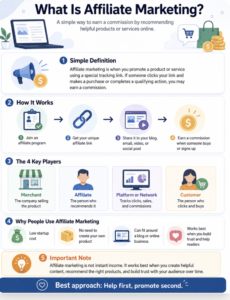
Affiliate marketing is a business arrangement between a company and a publisher, creator, or website owner.
The company gives the affiliate a unique tracking link. The affiliate then recommends the company’s product or service through a website, email, video, podcast, or social media account.
When someone clicks the link and completes a qualifying action, the affiliate may receive a commission.
That action could include:
- Purchasing a product
- Starting a paid subscription
- Requesting a quote
- Registering for a free trial
- Completing an approved application
The exact payment depends on the affiliate program’s terms.
You are not employed by the company, and you do not usually handle product development, shipping, billing, or customer support. Your role is to connect the right person with a suitable product.
How Affiliate Marketing Works
A basic affiliate transaction usually involves four parties.
Affiliate Marketing Pros and Cons
Affiliate marketing offers a practical way to build an online business, but it also requires patience, trust, and consistent work.
Pros of Affiliate Marketing
- Low startup costs: You do not need to create, manufacture, or store your own products.
- Flexible working options: You can build content around your own schedule and work from almost anywhere.
- Many niches and products: Affiliates can choose programs that closely match their audience and content.
- No customer order management: The merchant usually handles payments, delivery, refunds, and customer support.
- Content can produce long-term results: A useful article may continue attracting readers and affiliate clicks after publication.
Cons of Affiliate Marketing
- Income is not guaranteed: Traffic, clicks, and commissions can vary from month to month.
- Results usually take time: Building content, search visibility, and reader trust rarely happens overnight.
- Affiliate programs can change: Companies may reduce commissions, update rules, or close their programs.
- You do not control the product: Product quality, pricing, customer service, and refunds are managed by the merchant.
- Competition can be strong: Popular products and profitable niches may already have many established publishers.
The Merchant
The merchant owns the product or service. This could be a large retailer, software company, course provider, hosting company, or small independent business.
The Affiliate
The affiliate creates content and recommends the merchant’s offer.
Affiliates may use blog posts, tutorials, reviews, comparison articles, videos, newsletters, or social media content.
The Affiliate Network or Tracking Platform
Some companies manage their own affiliate programs. Others use networks such as Awin, impact.com, CJ Affiliate, Amazon Associates, or ClickBank.
The platform tracks clicks, approved sales, commissions, and payments.
The Customer
The customer reads or watches the affiliate’s content, clicks the tracking link, and decides whether to purchase.
A good affiliate marketer helps the customer make an informed decision. The goal is not to pressure people into buying something they do not need.
Quick Affiliate Marketing Success Checklist
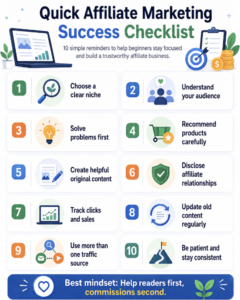
Before working through the 15 tips, remember these basic principles:
- Choose a clear niche.
- Understand your audience.
- Solve problems before promoting products.
- Recommend products carefully.
- Create original and useful content.
- Disclose affiliate relationships.
- Track what produces clicks and sales.
- Keep updating older content.
- Build more than one traffic source.
- Expect progress to take time.
Now let us look at each strategy in more detail.
1. Choose a Focused Affiliate Marketing Niche
A niche is the main subject your website or content covers.
“Health,” “technology,” and “making money” are broad markets rather than focused niches. A smaller and clearer niche makes it easier to understand who you are helping.
For example:
- Technology for older beginners
- Budget-friendly home offices
- WordPress tools for new bloggers
- Indoor cat care
- Gardening in dry climates
- Affiliate marketing for beginners
A focused niche helps you create connected articles that answer different questions for the same audience.
It also makes your recommendations feel more natural. A reader is more likely to trust a website that consistently covers one subject than a website promoting random products from unrelated categories.
Questions to Ask Before Choosing a Niche
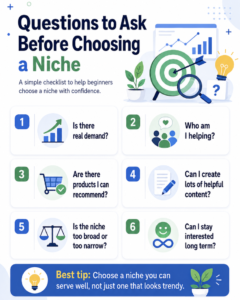
Ask yourself:
- Do people actively search for help with this subject?
- Are there products or services I could honestly recommend?
- Can I create at least 30 useful articles about it?
- Do I have experience, interest, or knowledge in this area?
- Can I offer something different from larger websites?
You do not need to be the world’s leading expert. However, you should be willing to learn, test products, research carefully, and improve your knowledge.
2. Understand the Reader Before Choosing Products
Many beginners join affiliate programs before understanding their audience.
That is the wrong order.
Start by finding out what your readers are trying to achieve. Look at the questions they ask, the mistakes they make, and what prevents them from moving forward.
For example, someone searching for a website-building platform may be concerned about:
- Cost
- Technical difficulty
- Hosting
- Training
- Customer support
- Hidden charges
- Whether the platform suits beginners
An article that addresses these concerns will be more useful than one that simply lists features.
Create a simple reader profile that answers:
- Who is this person?
- What problem are they facing?
- What have they already tried?
- What are they worried about?
- What result do they want?
- What information do they need before buying?
Products should be selected because they help your audience, not simply because they pay a large commission.
3. Build Content Around Problems, Not Products
People rarely wake up wanting to click an affiliate link.
They want to solve a problem.
Someone may want to:
- Build their first website
- Find affordable hosting
- Choose an email marketing service
- Improve their Google rankings
- Find a beginner-friendly affiliate platform
- Compare two online courses
- Avoid wasting money on the wrong tool
Your content should begin with that problem.
Instead of writing only about a product’s features, explain how those features affect the reader.
For example, do not simply say:
The platform includes website hosting.
Explain why it matters:
Hosting is included, so beginners do not need to purchase and connect a separate hosting service before building their first website.
That extra explanation helps readers understand the benefit.
4. Create People-First Content
Search engines are important, but your article still needs to satisfy a real person.
Google recommends creating helpful, reliable content for people rather than producing pages mainly to manipulate search rankings. It also encourages publishers to show genuine knowledge, experience, and clear authorship.
People-first affiliate content should:
- Answer the main question early
- Explain complicated points in simple language
- Include original observations
- Discuss disadvantages as well as benefits
- Avoid unrealistic earnings claims
- Help readers decide whether a product suits them
- Leave the reader with a clear next step
Do not stretch a simple answer across thousands of words merely to make an article longer.
A pillar article should be detailed because the subject requires detail, not because a certain word count guarantees rankings.
Add Your Own Experience
When possible, include:
- Screenshots you created
- Results from testing the product
- Problems you experienced
- Features you found useful
- Features you found disappointing
- Who you believe the product suits
- Who should consider another option
Your personal experience is something competing websites cannot copy accurately.
5. Match Keywords With Search Intent
A keyword tells you what someone typed into a search engine. Search intent tells you what they actually want.
Consider these searches:
- What is affiliate marketing?
- How do I start affiliate marketing?
- Best affiliate programs for beginners
- Awin vs Amazon Associates
- Is Wealthy Affiliate worth it?
- Wealthy Affiliate pricing
Although all relate to affiliate marketing, the person needs something different in each case.
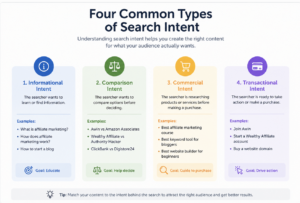
Four Common Types of Search Intent
Informational Intent
The person wants to learn.
Examples:
- What is an affiliate link?
- How does affiliate marketing work?
- How long does affiliate marketing take?
Comparison Intent
The person is comparing choices.
Examples:
- Awin vs CJ Affiliate
- Wealthy Affiliate vs Authority Hacker
- ClickBank vs Digistore24
Commercial Intent
The person is researching before buying.
Examples:
- Best affiliate marketing course
- Best keyword tool for bloggers
- Best website builder for beginners
Transactional Intent
The person is ready to act.
Examples:
- Join Awin
- Start a Wealthy Affiliate account
- Buy a website domain
Choose one main intent for each article. Trying to satisfy every possible search can make the page unfocused.
6. Build Topic Clusters Instead of Isolated Articles
One article rarely covers every question a reader has.
A topic cluster connects one broad pillar article with several more focused supporting articles.
For example, an affiliate marketing pillar page could link to supporting articles about:
- Choosing a profitable niche
- Finding affiliate programs
- Writing product reviews
- Creating comparison articles
- Conducting keyword research
- Building an email list
- Increasing website traffic
- Understanding affiliate links
- Avoiding beginner mistakes
The supporting articles should also link back to the main pillar post.
This structure helps readers move naturally through your website. It also gives search engines more context about your main subjects.
Google recommends using clear, crawlable internal links with descriptive anchor text. It also states that every important page should have at least one internal link pointing to it.
Instead of using vague anchor text such as “click here,” use descriptive wording such as:
- Learn how to find a profitable affiliate niche
- Compare the best affiliate platforms for beginners
- Read my beginner’s guide to keyword research
7. Choose Affiliate Programs Carefully
A high commission does not automatically make an affiliate program worthwhile.
A program may advertise a generous percentage but still be difficult to promote because the product is unsuitable, overpriced, poorly supported, or unknown to your audience.
Before joining, check:
- Product quality
- Company reputation
- Customer reviews
- Commission structure
- Tracking period
- Payment schedule
- Minimum payout
- Refund or cancellation rates
- Affiliate support
- Marketing restrictions
- Whether the product matches your readers
Read the program’s current terms rather than relying on old blog posts. Affiliate programs can change their commissions, tracking rules, payment methods, and promotional policies.
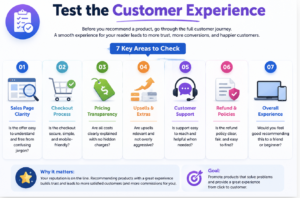
Test the Customer Experience
Where practical, look at the complete buying experience.
Ask:
- Is the sales page clear?
- Is the checkout secure and easy to use?
- Are the prices explained properly?
- Are there unexpected upsells?
- Is customer support easy to contact?
- Is the refund policy clear?
Your reputation is connected to the products you recommend.
8. Recommend Fewer Products More Carefully
A common beginner mistake is joining dozens of affiliate programs and promoting everything at once.
This creates scattered content and makes it harder to build authority.
Begin with a small group of products that strongly match your niche.
Learn:
- What each product does
- What makes it different
- Its strongest features
- Its limitations
- Its pricing structure
- Which type of buyer it suits
- Which competitors readers may consider
You can create several helpful articles around one suitable product:
- Full review
- Beginner tutorial
- Pricing guide
- Pros and cons
- Product comparison
- Frequently asked questions
- Troubleshooting guide
- Alternatives article
This approach is more focused than mentioning a product once and immediately moving to another one.
9. Write Balanced Product Reviews
Readers can recognize a one-sided sales pitch.
A trustworthy review should not describe every product as perfect. Even a good service will have limitations.
Include:
- What the product does
- Who created it
- Current pricing
- Main features
- What you liked
- What could be improved
- Who it suits
- Who should avoid it
- Suitable alternatives
- Your final verdict
Avoid declaring something a scam merely because you did not like it. Explain the evidence behind your conclusion.
Do not promise that readers will make a specific amount of money. Affiliate results depend on many factors, including experience, niche, content quality, traffic, consistency, expenses, and audience trust.
Explain Your Testing Method
Tell readers how you reached your conclusion.
For example:
- I used the platform for three years.
- I tested the free account.
- I compared the current pricing pages.
- I examined the training and website tools.
- I contacted customer support.
- I reviewed the affiliate terms.
This makes the review more useful and believable.
10. Place Affiliate Disclosures Where Readers Can See Them
Affiliate links should never be disguised as ordinary recommendations.
For content aimed at American readers, the Federal Trade Commission states that material connections between an endorser and a business should be disclosed clearly and conspicuously. A disclosure should be easy to notice and understand.
A simple website disclosure could say:
This post contains affiliate links. I may receive a commission if you purchase through one of these links, at no additional cost to you.
Place the disclosure near the beginning of the article before the first affiliate link.
A link to a general disclosure page in your footer may not provide enough context by itself. Readers should understand the relationship while viewing the recommendation.
Also check the rules that apply in your country and the terms of each affiliate program.
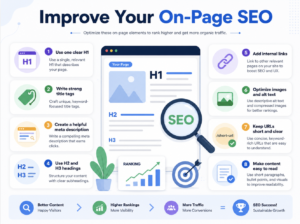
11. Improve Your On-Page SEO
Good on-page SEO helps search engines understand your page while making the article easier for readers to use.
Focus on the basics:
- Use one clear H1 heading.
- Include the primary keyword naturally.
- Write a useful introduction.
- Organize sections with H2 and H3 headings.
- Use short paragraphs.
- Add descriptive image alt text.
- Link to relevant internal pages.
- Cite trustworthy sources where needed.
- Write a clear SEO title and meta description.
- Keep the URL short and readable.
- Check the page on mobile devices.
Google explains that a title should be clear, concise, unique, and accurately describe the page. It also recommends a short, page-specific meta description that summarizes the most relevant information.
Do not repeat the same keyword in every paragraph. Use related words naturally and concentrate on answering the reader’s question.
12. Build an Email List Early
Search traffic can rise and fall. Social media platforms can change their algorithms. Affiliate programs can also close or reduce commissions.
An email list gives you a direct way to contact readers who have chosen to hear from you.
You could offer a useful free resource such as:
- Beginner affiliate checklist
- Keyword research worksheet
- Product comparison guide
- Website launch checklist
- Content planning template
- Short email course
The free resource should closely match your website’s subject.
For example, someone reading an affiliate marketing article may be interested in a beginner’s affiliate marketing checklist. They may not be interested in an unrelated recipe book.
Do not send one sales email after another. A useful email sequence should educate, build familiarity, and recommend products only when they are relevant.
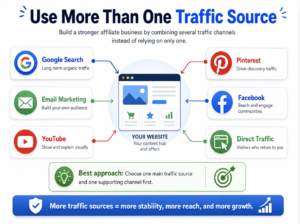
13. Use More Than One Traffic Source
SEO can be valuable, but relying on one traffic source leaves your business vulnerable.
You might combine:
- Google search traffic
- Bing search traffic
- Email marketing
- YouTube
- Online communities
- Direct visitors
- Referral traffic from other websites
You do not need to use every platform.
Choose one main traffic source and one supporting channel. Learn how they work before adding more.
For example, a blogger might use SEO as the main strategy, an email list to retain readers, and YouTube to demonstrate products visually.
Repurpose strong ideas rather than creating unrelated content for every platform.
A detailed article could become:
- A short video
- An email lesson
- A checklist
- Several social posts
- A comparison graphic
- A frequently asked questions section
14. Track Clicks, Conversions, and Content Performance
Without tracking, you may continue working on content that brings traffic but produces no useful action.
Important measurements include:
- Search impressions
- Search clicks
- Average search position
- Page visits
- Affiliate link clicks
- Conversion rate
- Approved sales
- Commission earned
- Email signups
- Most successful articles
Traffic alone does not tell the complete story.
An article with 200 highly targeted visitors may produce better results than a general article with 2,000 visitors.
Look for patterns.
Which articles attract buyers? Which products receive clicks? Which pages bring email subscribers? Which calls to action are ignored?
Use this information to decide what to improve next.
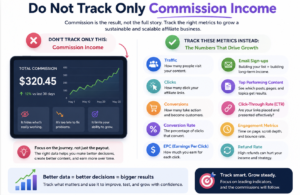
Do Not Track Only Commission Income
Also monitor:
- Whether readers remain on the page
- Which sections receive attention
- Whether visitors continue to another article
- Whether links work
- Whether product details are still correct
- Whether the page works properly on mobile devices
Google uses the mobile version of a website’s content for indexing and ranking, so the page should provide a complete and usable mobile experience.
15. Update Older Affiliate Content
Affiliate articles can become outdated quickly.
Products change. Prices increase. Companies rebrand. Affiliate platforms close. Features disappear. New alternatives enter the market.
Review important articles regularly and check:
- Product availability
- Program availability
- Prices
- Features
- Screenshots
- Broken links
- Company names
- Commission information
- Disclosure wording
- Internal links
- Dates in headings
- Frequently asked questions
- Calls to action
Do not change the publication date merely to make an old article look new.
Make meaningful improvements first. Then show readers when the article was genuinely updated.
A strong update may involve:
- Rewriting the introduction
- Replacing outdated sections
- Adding personal experience
- Improving the headings
- Answering new questions
- Updating screenshots
- Removing unsupported claims
- Adding current alternatives
- Strengthening internal links
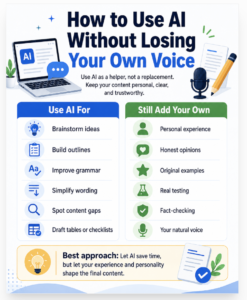
How to Use AI Without Losing Your Own Voice
AI tools can help with planning, organizing ideas, proofreading, and identifying gaps. However, they should not replace your judgment, experience, fact-checking, or final editing.
Google does not automatically reject content merely because automation was involved. The problem arises when large amounts of unoriginal content are produced mainly to manipulate rankings rather than help readers.
Use AI to assist with tasks such as:
- Brainstorming article questions
- Organizing an outline
- Finding repeated sentences
- Simplifying difficult wording
- Creating a first draft of a table
- Checking grammar
- Suggesting missing subtopics
Then add what the tool cannot genuinely provide:
- Your own experience
- Original screenshots
- Accurate product testing
- Personal observations
- A balanced opinion
- Verified current information
- Your natural writing voice
Always check names, dates, prices, features, quotations, and statistics before publishing.
Common Affiliate Marketing Mistakes to Avoid
Even a strong strategy can be weakened by avoidable mistakes.
Choosing Products Only for the Commission
A large commission is worthless when the product does not suit your audience or convert well.
Promoting Too Many Unrelated Products
Random promotions confuse readers and weaken your website’s focus.
Publishing Thin Product Reviews
A review that repeats the company’s sales page adds little value. Include analysis, limitations, comparisons, and experience.
Hiding Affiliate Relationships
Clear disclosures protect trust and help readers understand why a tracking link is being used.
Expecting Immediate Results
A new website usually needs time to build content, trust, visibility, and traffic. There is no guaranteed timetable.
Ignoring Email Marketing
A visitor may not be ready to buy during their first visit. An email list gives you another opportunity to help them.
Depending on One Affiliate Program
A program can change its rules or close. Build relationships with more than one suitable merchant over time.
Forgetting to Update Old Articles
An outdated price or broken affiliate link can cost sales and damage credibility.
Writing for Search Engines Instead of Readers
Keywords may attract the click, but useful content earns trust.
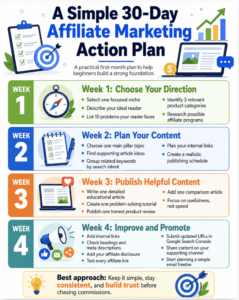
A Simple 30-Day Affiliate Marketing Action Plan
You do not need to complete everything at once. Here is a practical first-month plan.
Week 1: Choose Your Direction
- Select one focused niche.
- Describe your ideal reader.
- List ten problems your reader faces.
- Identify three relevant product categories.
- Research possible affiliate programs.
Week 2: Plan Your Content
- Choose one main pillar topic.
- Find supporting article ideas.
- Group related keywords by search intent.
- Plan your internal links.
- Create a realistic publishing schedule.
Week 3: Publish Helpful Content
Create:
- One detailed educational article
- One problem-solving tutorial
- One honest product review
- One comparison article
Concentrate on usefulness rather than publishing quickly.
Week 4: Improve and Promote
- Add internal links.
- Check your headings and meta descriptions.
- Add your affiliate disclosure.
- Test every affiliate link.
- Submit updated URLs through Google Search Console.
- Share the articles through your chosen supporting channel.
- Begin planning a simple email freebie.
At the end of the month, review what you completed and choose the next manageable step.
How Long Does Affiliate Marketing Take to Work?
There is no standard timetable.
Some affiliates earn a first commission quickly because they already have an audience. Others spend months building content before seeing meaningful results.
Progress can depend on:
- Your niche
- Competition
- Website age
- Content quality
- Publishing frequency
- Product demand
- Search visibility
- Email list size
- Social media reach
- Reader trust
- Conversion rates
- The time available to work on the business
Treat affiliate marketing as a long-term business rather than a quick-money plan.
Your first goal should not be replacing a full-time income. A better first goal is building a useful website, publishing a group of connected articles, receiving targeted visitors, and learning which content produces clicks.
Frequently Asked Questions
Clear answers to common questions about starting affiliate marketing in 2026.
Is affiliate marketing still worth starting in 2026?
Yes. Affiliate marketing can still be a practical online business model when you create useful content, recommend suitable products, and build trust with a specific audience.
However, it is not quick or effortless income. Building a reliable affiliate business takes time, consistent work, and a willingness to learn.
Can beginners start affiliate marketing?
Yes. You do not need to create your own product or have previous marketing experience.
Start with one focused niche, one main content platform, and a small number of relevant affiliate programs. Learn the basics before trying to expand.
Do I need a website for affiliate marketing?
Not always. Some affiliate programs accept established YouTube channels, newsletters, podcasts, or social media accounts.
However, owning a website gives you more control over your content, search traffic, email list, internal links, and long-term brand. Always check the requirements of each affiliate program before applying.
How much does it cost to start affiliate marketing?
Your starting cost depends on the tools and platform you choose. Common expenses may include a domain name, website hosting, email marketing software, and optional research or design tools.
You can begin with a modest setup, but affiliate marketing is not always completely free. Paid advertising is optional and is not necessary for every beginner.
Can AI write affiliate marketing articles?
AI can help with brainstorming, outlines, first drafts, and proofreading. However, it should not replace your own experience, research, judgment, or final editing.
Always check facts, prices, features, and product claims before publishing. Add your own examples and opinions so the article remains useful and trustworthy.
What is the most important affiliate marketing tip?
Help the reader before trying to make a sale.
People are more likely to trust your recommendations when your content is useful, honest, balanced, and based on careful research or genuine experience.
Final Thoughts: Build Trust Before Chasing Commissions
Affiliate marketing works best when the reader comes first.
Choose a clear audience. Understand their problems. Publish useful content. Recommend products carefully. Explain both the benefits and limitations. Keep your information updated.
You do not need to use every marketing strategy at once.
Start with one niche, one main traffic source, a small group of trustworthy products, and a realistic content schedule. Improve what you publish as you gain more experience.
The strongest affiliate websites are not built around constant selling. They are built around helping readers make confident decisions.
That is how trust grows, and trust is what gives affiliate marketing the chance to become a real long-term business.
Ready to Take the Next Step?
Read my complete Affiliate Marketing for Beginners guide to learn how to choose a niche, build your website, create helpful content, and grow your online business.
When you are ready to put those steps into action, Wealthy Affiliate gives beginners the training, tools, hosting, and support needed to get started.
Thank you for stopping by.
Elke 😀
Thanks for reminding the basics of affiliate marketing! It’s true that affiliate marketing involves being a great content writer; and engage your audience as well. Also, it means that you must work everyday, at least one hour per day on your business. I’ve learnt that and I’m very happy to work on my affiliate business as well right now. Thanks a lot for your very informative article, especially on the improvements you can make with AI.
Hi Angelce
Thank you for your thoughtful comment! I’m glad you found the article on affiliate marketing helpful. You’re absolutely right—being a great content writer and engaging your audience are crucial aspects of affiliate marketing. Consistency is key, and dedicating at least an hour a day to your business can make a big difference.
I’m thrilled to hear you’re enjoying working on your affiliate business and that the information on AI improvements was useful to you. If you have any questions or need more tips, feel free to reach out.
Best of luck with your affiliate marketing journey!
Best regards,
Elke