

How to Make Money Online: 7 Steps to Turn Site Visitors into Commissions in 2026
We may earn money or products from the companies mentioned in this post.
Updated September 2026

7 Ways to Turn Site Visitors Into Commissions in 2026
Getting visitors to your website is an important achievement.
But traffic by itself does not create an affiliate business.
A visitor can arrive from Google, read your article, and leave without clicking anything. Another person may stay for several minutes, visit two or three pages, click an affiliate link, and eventually make a purchase.
The difference is often what happens after they arrive.
Learning how to turn site visitors into commissions means creating a clear path between the reader’s question and the solution you recommend.
That does not mean covering every page with affiliate buttons.
It means understanding what the visitor wants, answering their questions, building enough trust for them to consider your recommendation, and giving them a clear next step.
If you are completely new to affiliate marketing and have not built this foundation yet, start with my guide on how to start affiliate marketing in 2026.
If you already have content and visitors, the seven steps below will help you concentrate on conversion rather than simply chasing more traffic.
Traffic and Conversions Are Not the Same Thing
It is easy to become focused on visitor numbers.
More traffic can create more opportunities, but only when the right people are reaching the right pages.
Imagine two websites.
Website A receives 10,000 visitors, but most are looking for general information and have little interest in the products being recommended.
Website B receives 2,000 visitors, but many arrive through product reviews, comparisons, pricing questions, and tutorials related directly to the products being promoted.
Website B may have fewer visitors but a much stronger opportunity to earn affiliate commissions.
This is why the goal should not simply be:
Get more traffic.
A better goal is:
Attract the right visitor and make the next step obvious.
If generating organic traffic is still your main challenge, my guide on how to rank your affiliate website in 2026 covers that side of the process.
This article starts once those visitors arrive.

1. Match the Page to What the Visitor Wants
The first step in learning how to turn site visitors into commissions is understanding why someone landed on the page.
Different searches indicate different levels of interest.
Someone searching:
What is affiliate marketing?
is probably learning.
Someone searching:
Is Wealthy Affiliate worth it?
is investigating a specific product.
Someone searching:
Wealthy Affiliate vs another platform
may be much closer to making a decision.
These visitors should not all receive the same type of content.
Match Content to the Reader’s Stage
A useful website normally has several types of pages:
- Informational guides
- Tutorials
- Product reviews
- Comparison articles
- Alternatives articles
- Pricing guides
- Pros and cons articles
- Beginner guides
Each page has a different job.
Your informational content can attract readers and build trust.
Your commercial content can help people make decisions.
Do not force a sale into an article where the visitor is only trying to understand a basic concept.
Instead, give them the answer they came for and then provide a natural path to more detailed information.
Look at the Question Behind the Search
Before adding a product recommendation, ask:
- Why did this person arrive here?
- What question are they trying to answer?
- What information do they need before making a decision?
- Is a product recommendation appropriate on this page?
- What should they logically read next?
This keeps your recommendations relevant.
A relevant recommendation has a much better chance of receiving a click than a random affiliate offer inserted because it pays a good commission.
2. Make the First Part of the Page Earn Attention
Visitors make quick decisions about whether a page looks useful.
Your introduction should confirm that they have reached the right place.
Avoid spending several paragraphs talking about unrelated background information before answering the question.
Get to the point.
A Strong Introduction Should Do Three Things
It should:
- Confirm the problem or question
- Explain what the article will help with
- Give the reader a reason to continue
For example, if someone arrives on a product comparison page, they probably do not need a long explanation of what affiliate marketing is.
They want to know how the products differ.
Tell them.
Remove Unnecessary Distractions
A conversion-focused page should be easy to use.
Watch for:
- Too many popups
- Large advertisements interrupting the article
- Several competing calls to action
- Long introductions
- Confusing navigation
- Difficult-to-read paragraphs
- Links that have little connection to the subject
Your visitor should be able to understand the page without fighting through the design.
If the structure of your site itself needs improvement, my guide on how to build an affiliate website and write content that converts explains the broader website setup and content structure.
3. Build Trust Before Asking for the Click
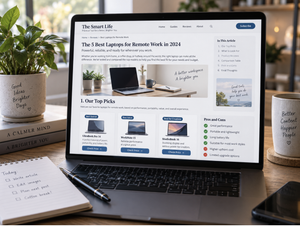
Affiliate marketing depends heavily on trust.
Readers know that websites make money from recommendations.
The problem is not earning a commission.
The problem appears when the recommendation feels more important than helping the reader.
If every product is described as amazing, perfect, or essential, people may become skeptical.
Give Readers the Complete Picture
When discussing a product, consider including:
- What the product does
- Who it is designed for
- Who may not need it
- What you like
- What could be improved
- The current pricing structure
- Important limitations
- Alternatives
- Your personal experience when relevant
- Your final recommendation
Honesty can make a recommendation stronger.
If a cheaper option is better for some people, say so.
If the premium plan is unnecessary for beginners, explain that.
If a feature is useful but difficult to learn, mention it.
Readers are making decisions with their own money.
Help them make an informed one.
Show Experience Where You Have It
First-hand experience is particularly useful in affiliate content.
You can add:
- Original screenshots
- Examples from your own website
- Results you have personally observed
- Features you have tested
- Problems you encountered
- What changed after you used the product
That makes the article more useful than simply rewriting information from the merchant’s website.
4. Recommend Products Where They Solve a Specific Problem
One reason affiliate pages fail to convert is poor product placement.
A reader may be interested in the article but have no reason to click the product being promoted.
To turn site visitors into commissions, the recommendation should connect directly to the problem being discussed.
Think Problem → Solution
For example:
Problem: The reader cannot find suitable keywords.
Solution: Recommend a keyword research tool and explain why it helps.
Problem: The reader needs structured affiliate marketing training.
Solution: Introduce a training platform and link to your full review.
Problem: The reader is comparing two services.
Solution: Explain the differences and help them decide which one better fits their circumstances.
Do not jump straight from the problem to a button.
Explain the connection.
Use Reviews as Decision Pages
A detailed review gives readers somewhere to investigate a recommendation before visiting the merchant.
For example, rather than simply telling someone to join Wealthy Affiliate, you could direct them to my real Wealthy Affiliate 2026 review where they can examine the features, advantages, drawbacks, and who the platform suits.
That creates a more natural path:
Helpful article → Product review → Affiliate link → Merchant
The reader receives more information at each stage.
Do Not Promote Too Many Products on One Page
More products do not automatically mean more commissions.
Too many choices can make a page confusing.
If five products all appear to be your number-one recommendation, the reader may not know what to choose.
Select products because they fit the article.
Not because you happen to have an affiliate link.
5. Place Affiliate Links Where Readers Need Them
Affiliate links work best when they appear at a logical decision point.
If you are new to the mechanics behind these links, my guide explaining how affiliate links work covers tracking, commissions, disclosures, and the basic process.
For conversion purposes, placement matters.
For more guidance on affiliate disclosures, see the FTC’s official Endorsement Guides, which explain how affiliate relationships should be disclosed clearly to readers.
Useful Places for Affiliate Links
Consider placing a relevant affiliate link:
- After explaining the main benefit
- After showing how a product solves a problem
- Near pricing information
- After a comparison
- After pros and cons
- Near your final recommendation
- Inside a clear call-to-action button
The link should appear when the reader has enough information to understand why they may want to click it.
Avoid Filling Every Paragraph With Links
Repeated affiliate links can make an article feel aggressive.
You do not need a button after every heading.
Think about where the reader is likely to make a decision.
Then provide the next step.
Use Clear Anchor Text
Your anchor text should help the reader understand what happens when they click.
Instead of:
Click here
consider:
Read my complete Wealthy Affiliate review
or:
See the current membership options
Clear anchor text removes uncertainty.
6. Use Calls to Action That Match the Reader’s Decision
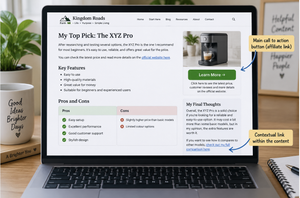
A call to action tells your visitor what to do next.
Without one, readers may finish a useful section and simply leave.
That does not mean every CTA needs to say:
BUY NOW!
In many cases, a softer and more specific next step works better.
Useful Affiliate CTA Examples
Depending on the page, you might use:
- Read the full review
- Compare the two options
- See the current plans
- Check the latest pricing
- Try the free version
- View the available features
- See who this product is best for
- Learn how the platform works
These tell the reader what they will receive after clicking.
Match the CTA to the Page
A beginner guide might use:
Learn More
A detailed product review could use:
See the Current Plans
A comparison article could use:
Compare the Membership Options
A free-trial offer could use:
Try It Free
The call to action should match what the visitor is ready to do.
Do Not Make Every CTA Compete
If one section contains:
- Join now
- Download this
- Subscribe
- Read another article
- Watch this video
- Buy this product
the visitor may choose none of them.
Give important sections one obvious next step.
7. Track Where Visitors Stop and Improve That Point
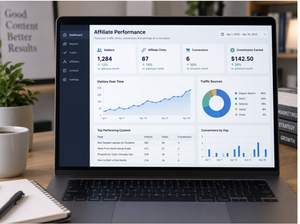
The final step is measurement.
You cannot improve conversions effectively if you do not know what visitors are doing.
Do not assume that low commissions automatically mean you need more traffic.
The problem may be somewhere else in the path.
Look at the Entire Visitor Journey
A simple journey might look like this:
Google → Article → Product recommendation → Affiliate link → Merchant
Now look for the weak point.
Visitors Arrive but Leave Quickly
The problem may be:
- Search intent mismatch
- Weak introduction
- Slow loading
- Difficult layout
- Poor-quality content
- The answer being difficult to find
Visitors Read but Do Not Click Affiliate Links
Look at:
- Product relevance
- Affiliate-link placement
- Calls to action
- Whether the recommendation is clear
- Whether enough trust has been established
- Whether you explained why the product is useful
Visitors Click One Product Far More Than Another
That is useful information.
Ask why.
Perhaps:
- It fits your audience better
- Your review is stronger
- The CTA is clearer
- The price is more attractive
- The problem-solution connection is stronger
Instead of promoting ten more products, you may achieve more by improving the pages connected to the product that already performs.
Improve Existing Pages Before Creating More
If an article already receives traffic, investigate whether you can improve it before writing another article on the same subject.
You might improve:
- Product placement
- CTAs
- Internal links
- Introductions
- Comparison tables
- Pros and cons
- Screenshots
- Pricing information
- Affiliate disclosures
- Mobile readability
This can improve the value of traffic you already have.
Create a Clear Path Through Your Website
A strong affiliate website should not feel like a collection of unrelated blog posts.
Your articles should work together.
Imagine someone arrives on an informational article.
They learn the basics.
A relevant internal link takes them to a more detailed guide.
That guide leads to a product comparison.
The comparison leads to an honest review.
The review contains the affiliate recommendation.
That journey could look like:
Information → Education → Comparison → Review → Affiliate Offer
Not every reader will follow the same path.
That is fine.
Your job is to make useful paths available.
Do Not Forget Mobile Visitors
Many readers will view your website on a phone.
Check your important affiliate pages on mobile.
Look at:
- Paragraph length
- Button size
- Image size
- Page speed
- Tables
- Popups
- Menus
- Affiliate-link placement
A button that looks attractive on a desktop may be awkward on a smaller screen.
A comparison table may also become difficult to read.
Make important pages easy to use regardless of screen size.
What Should You Measure?
Do not look only at total visitor numbers.
For conversion-focused affiliate content, monitor:
- Visitors to important commercial pages
- Affiliate-link clicks
- Click-through rate on important CTAs
- Product review traffic
- Comparison-page traffic
- Pages visitors enter from
- Pages visitors visit next
- Products receiving the most clicks
- Products producing commissions
- Pages receiving traffic but very few affiliate clicks
This information tells you where improvements are most likely to matter.
Common Mistakes That Reduce Affiliate Conversions
Avoid these common problems:
- Recommending products that do not match the article
- Using too many affiliate links
- Hiding product disadvantages
- Giving every product a glowing review
- Using vague calls to action
- Sending readers directly to products without enough explanation
- Promoting too many products on one page
- Ignoring mobile usability
- Focusing only on visitor numbers
- Publishing another article instead of improving a page that already receives traffic
- Creating several pages with almost identical search intent
The last point is particularly important.
Your articles should support one another rather than compete for the same search.
How Many Visitors Do You Need to Earn Affiliate Commissions?
There is no fixed number.
A website with relatively modest but highly relevant traffic can outperform a larger website with poorly targeted visitors.
The quality of the traffic matters.
So do:
- Search intent
- Product fit
- Reader trust
- Content quality
- Affiliate-link placement
- Calls to action
- Merchant conversion
- Product pricing
- The strength of the offer
Do not assume that reaching a particular monthly visitor number automatically produces a certain income.
Affiliate marketing does not work that predictably.
Can You Turn Every Site Visitor Into a Commission?
No.
And you should not try.
Some visitors are only researching.
Some are not ready to buy.
Some will prefer another product.
Some will return later.
Some may never purchase anything.
Your goal is not to pressure every visitor into clicking an affiliate link.
Your goal is to help the visitors who are interested move toward the right solution.
That creates a healthier long-term affiliate business.
A Simple 7-Step Conversion Checklist
Before updating an important affiliate page, check:
- Does the page match what the visitor searched for?
- Does the introduction quickly confirm that the reader is in the right place?
- Have I given the reader enough information to trust my recommendation?
- Does the product solve the problem discussed on the page?
- Are affiliate links placed at logical decision points?
- Is there a clear and relevant call to action?
- Am I tracking what visitors click and improving weak points?
You do not need to redesign your entire website at once.
Start with the pages already receiving visitors.
Improve one page.
Watch what happens.
Then move to the next.
Pros and Cons of Turning Site Visitors Into Commissions
Pros
- You can make better use of traffic you already have.
- Relevant product recommendations can increase affiliate clicks.
- Clear calls to action help readers understand the next step.
- Better internal linking can guide visitors toward reviews and comparison pages.
- Trust-focused content can improve both engagement and conversions.
- Tracking clicks and behavior makes it easier to improve weak pages.
Cons
- Not every visitor is ready to buy.
- More traffic does not automatically mean more commissions.
- Poor product fit can reduce clicks and reader trust.
- Too many affiliate links can make a page feel overly promotional.
- Conversion improvements often require testing and regular updates.
- You still depend on the merchant to complete the sale after the click.
Frequently Asked Questions
How Do I Turn Website Visitors Into Affiliate Sales?
Start by making sure the article matches the visitor’s search intent. Recommend products that solve the problem being discussed, explain why they are relevant, place affiliate links at logical decision points, and use a clear call to action.
Why Do I Get Traffic but No Affiliate Sales?
Traffic without sales can have several causes. Your visitors may be looking for information rather than products, your recommendation may not fit the page, your call to action may be unclear, or readers may click but decide not to buy from the merchant.
How Can I Increase Affiliate Link Clicks?
Make the recommendation relevant, explain the product before presenting the link, use descriptive anchor text, and place affiliate links where readers are naturally making a decision.
Should I Put Affiliate Links in Every Article?
No. Add affiliate links when they genuinely help the reader. Some informational articles are better used to build trust and internally guide readers toward more commercial content.
How Many Affiliate Links Should I Add to a Page?
There is no ideal number. Use enough links to make the next step convenient without making the article look crowded, repetitive, or overly promotional.
Ready to Put These 7 Steps Into Action?
Knowing how to turn website visitors into commissions is important, but having the right tools and training can make the process much easier.
Wealthy Affiliate gives you step-by-step affiliate marketing training, website tools, keyword research, hosting, and a community where you can ask questions when you get stuck.
If you are serious about building an affiliate website and want everything in one place, Wealthy Affiliate is worth taking a closer look at.
Affiliate disclosure: I may earn a commission if you join Wealthy Affiliate through my link, at no extra cost to you.
Final Thoughts: Turn Site Visitors Into Commissions by Helping Them Decide
Learning how to turn site visitors into commissions is not about squeezing more sales out of every person who reaches your website.
It is about creating a better journey.
Understand why the reader arrived.
Answer the question.
Earn their trust.
Recommend a suitable solution.
Explain why it may help.
Make the next step clear.
Then measure what happens and improve the pages that show potential.
Your visitors are not statistics on an analytics screen.
They are people looking for information, reassurance, comparisons, or solutions.
Help them make a better decision first.
The commissions can follow from there.
Thank you for reading. I hope these seven steps help you make better use of the traffic you already have and turn more of the right site visitors into commissions in 2026.
Elke
Another great way to make money through affiliate marketing is through Google adsense. I have been using it for some time now and I have been making a crazy amount of money. It has truly changed my life for the better and I would recommend everyone to try it out. The acceptance process is long and hard though so be prepared to work
Thank you for your comment Aubin,
I also have signed up for Google AdSense but still waiting for some minor details to be taken care of on the Googles end.
I already made some money but it has to be approved once Google has fixed everything they have to do.
It is a great way to make money and there is a bit of work for it all to be set up.
Thanks again for your comment
Elke
I am glad I found your post. It has not only informed me about affiliate marketing. It has also made me excited to get started promoting products online. I have a couple of areas in which I could give expert advice so I will continue to narrow it down till I pick one. Thank you very much!
Thank You for your comments, Abel,
I am glad that you have enjoyed my article I am always happy if someone likes my blog and I could help.
I myself love Affiliate Marketing and it is a good way to earn income.
Thank you again and Good Luck
Elke